Showing posts with label India. Show all posts

Sunday, October 18, 2009

Dictator Democracy

http://timesofindia.indiatimes.com/home/opinion/edit-page/Dictator-democracy/articleshow/5120815.cms
An article Re-print of Jug Suraiya's Dictator Democracy on the ToI. While the treatment of the subject is sarcastic and humorous, it asks a very sensitive question: Whether government decrees and force feed democrcay like the one in Maharashtra is in true spirit of democracy.

Can democracy be a democracy and a dictatorship, both at the same time? Yes, it can, if it's Indian democracy. The Maharashtra government decreed that when the state went to assembly polls, Mumbai would forcibly be shut down shops, restaurants, schools, offices, factories, all closed so that people, with nothing else to be distracted by or to do, would be forced to vote.

The reason for this drastic measure to force-feed democracy or at least elections to Mumbaikars is that the otherwise 'can do' city is notoriously 'can't do' or 'won't do' when it comes to voting. This was evident in the last Lok Sabha polls in which the voter turnout was just over 40 per cent. The fact that the polls coincided with a long weekend which lured many Mumbaikars to out-of-town holidays was deemed to be largely responsible for the poor showing. However, sarkari concern was voiced over the seeming political apathy of a city which had just suffered a murderous terrorist attack and should have been all gung-ho about manning the barricades of democracy as represented by the ballot box, instead of swanning off on holiday.

To preclude the possibility of the assembly elections also proving a non-event in terms of turnout, the authorities reportedly issued orders that anyone failing to comply with the shutdown diktat was liable to face arrest under Section 135-B of the Representation of the People Act, 1951. To ensure compliance with this closed-door policy, special squads patrolled the city to make sure that no one was subverting democracy by trying to sneak into a school, or an office, or a factory, or a shop, or a restaurant. Go to vote. Or you might find yourself in jail: that was the message, willy-nilly, that officialdom sent out not just to Mumbaikars but to all of us who are citizens of this democracy.

Mumbai's case is symptomatic of a fundamental problem of our democracy. Democracy is supposed to be about empowering people, the common citizens, and helping them to get on with their daily lives as best they can (by going to schools, offices, factories, etc). But our sarkar seems convinced that democracy is only about empowering itself, at the expense of the people and their day-to-day needs.

India's political class and the successive governments that it forms, and which often comprise the strangest of bedfellows sees democracy only in terms of elections. It doesn't really matter which party comes into power, for in the end as a number of blatantly opportunistic alliances and coalitions have shown they are all fundamentally the same: cynical exploiters of the people.

Or at least that's the message that all our political parties have over the years been communicating, consciously or otherwise, to an increasingly sceptical electorate. The way our political parties, all our political parties of all shades and stripes, appear to see it is that the function of our democracy is only to hold periodic elections in which voters will, forcibly if necessary, vote one or other, or several, of these parties into power. Having fulfilled that basic duty (of having voted a politician into power) the voter can go jump. The voter's and the politician's democratic responsibility is over. Elections are the end all and be all of our democracy. And never mind what happens in between, never mind the persistent hardships and despair that citizens continue to face in their daily lives.

This is the real meaning of the Mumbai bandh on polling day: in our democracy the voter has no right of education, employment, earning a livelihood, whatever other than the right to vote. Indeed, as the Mumbai authorities would have it, the voter's right to vote is not just a right but an enforceable obligation. In other words, you've got to vote, whether you like it or not, whether you feel it's going to better your daily life in any way or not.

Jai ho to the democratic dictatorship of India that is Bharat.

Tuesday, August 25, 2009

Crisis @ BJP (From Bad to worse): The expulsion of Jaswant Singh

To my mind, BJP could have done without this Jaswant Singh episode. At a time, when the party is not able to come to grips with its identity in shaping India and RSS still tugs at the umbilical cord of ideology, the expulsion of Jaswant Singh who has been a BJP stalwart could be the beginning of the end of BJP. The reason of expulsion is cited as criticism of Sardar Vallabhbhai Patel, a BJP icon and praise of Jinnah which supposedly has irked the Sanghis and BJP leaders. Jaswant Singh had earlier criticized L K Advani for the poll debacle. The top brass in BJP are hoping that this action would serve as a warning to the deviators from the RSS-BJP ideological line.
Jaswant Singh’s book, Jinnah: India-Partition-Independence, upset the Sangh and the BJP not for its attempt to give the founder of Pakistan a flattering makeover, but for showing Sardar Vallabhbhai Patel in a poor light in the process. Allegedly, Jaswant Singh has blamed Patel for allowing the partition, backing the two nation theory and adopting a hard stand that “alienated” muslims. This is the second time someone in BJP has suffered on account of Jinnah. L K Advani lost his job as the party chief in 2005 for praising Jinnah while on a tour of Pakistan.

If the BJP was hoping to project itself as a democratic, moderate party which could accommodate differing points of view, this expulsion puts paid to all that.In an earlier post sometime back , I had written about how BJP and CPIM need to look beyond the hardline ideologies in order to stay relevant in changing times. This action goes to prove that BJP is still heavily biased by the RSS. After its electoral defeat, BJP simply is not able to get its act together. With squabbles among its leadership, BJP seems to have forgotten its duty to the country: that of holding a responsible chair of opposition. Sticking to Hindutva hardline could be a ploy with diminishing returns in the long term for the saffron party. For once it has to emerge from its Saffron mould and probably go green.


http://newspaper-posts.blogspot.com/2009/06/is-it-time-for-bjp-and-left-to-rift.html
http://newspaper-posts.blogspot.com/2009/06/bjp-imploding-part-i-lack-of-coherent.html
http://newspaper-posts.blogspot.com/2009/06/bjp-imploding-part-ii-lack-of-electoral.html
http://newspaper-posts.blogspot.com/2009/06/bjp-imploding-part-iii-lack-of.html

The virtues of a good drought!


It is now official. We are in the middle of the worst drought since independence.Ten states have declared 246 districts as drought hit. This is about 47% of the total districts in the country.Rice production is also expected to go down by 10 million tones. However India does have enough food reserves to meet any shortfall for the next 13 months. The fall in rice production works out to as much as 70% of what the country holds as buffer or emergency stock. Foodgrain demand for 2008-09 has been estimated at 219.01 million tones as against 233.88 million tonnes produced. India currently needs 7.2 million tones of Rice as buffer and has about 14.1 million tones. The current buffer for wheat is 7 million tones while the country has 15 million tones. This will help the country avoid the need to import. Congress party spokesman Janardhan Reddy has issued an advisory to the government to tackle the most important fall out of a drought season: the rise in food prices. Already, Congress has drafted a “drought-code” for its members, whereby Congress MPs, legislators and salaried officeholders will contribute 20% of their basic salary to state and central exchequer in a symbolic gesture of solidarity with those battling drought and price rise.


To a certain extent, the concerns about its impact on growth are valid but less so compared to the previous droughts: partly because agriculture accounts for much less of national income now than it did during previous droughts and partly because other sectors of the economy are less dependent on agriculture than they were earlier. The concerns are valid but are not as important for growth as they are for livelihood and food security, since at least half of India’s population still depends on agriculture for its livelihood and that is not much different from previous spells of drought.


This drought is a grim reminder of the fact that not all of boom in agriculture was driven by government policy. It is an altogether different matter that the rain gods hardly ever get credit for good monsoons. However, droughts have also presented the unique opportunity to governances in their time to innovate social solutions. Earlier droughts have now become landmark events for public policy depending on a government’s ability to convert challenges into opportunities.


The first major drought after independence was in the mid-1960s, with severe consequences for food security. But the government of the day was successful in converting the challenge into a golden opportunity. The opportunity was the green revolution and by the end of the next decade we were more or less self-sufficient in food. It was also successful in increasing irrigation on a much bigger scale than in the previous decades.


The second major public policy lesson was also a response to droughts. The much-appreciated National Rural Employment Guarantee Act (NREGA) is a successor of such a policy initiative. It was the Maharashtra Employment Guarantee Scheme which was started initially as a drought relief programme that formed the basis of a unique experiment in the world to provide guaranteed employment to the rural poor.


The importance of public employment programmes was also appreciated in the 1987-88 drought, which incidentally also saw a significant reduction in rural poverty for the first time. This was ably supported by the public policy of keeping cereal prices low and providing food security to the poor.


The 2002-03 drought was again severe and manifested itself in large-scale farmer suicides, but it also exposed the limitations of credit delivery in rural areas. The rapid expansion of credit in rural areas subsequently has not been enough to correct the serious imbalances on that front but it was successful in emphasising the magnitude of the problem. But more than that, it did provide the background for emphasising the importance of public employment programmes. The result is NREGA.


So what kind of opportunity does this drought throw up? In the long run, this drought has highlighted the vulnerabilities of Indian agriculture to the seasonal monsoons, despite claims of record production in the last four years. There cannot be a better time to usher a second green revolution and create a sustainable food security environment. It is high time to take up the long-term challenge of investing in agriculture and particularly on creating long-term sustainable irrigation systems. These may not be large-scale irrigation systems alone but even small water harvesting and conservation works undertaken as part of NREGA. But, in the short run, it is the best time to strengthen NREGA and expand its scope to individual entitlement from the existing household entitlement.


This drought is also a golden opportunity to convert this challenge into a successful public policy initiative. This opportunity is the enactment of the Right to Food Act. There cannot be a better time to do this. There is already a political consensus. This is also the time when the government stocks are full of foodgrain and it is economically insulated because of high growth achieved in the previous four years. This government has the option of being remembered for having faced the worst drought since independence or being remembered for successfully fighting it by enacting the Right to Food Act.
Ref: http://www.livemint.com/2009/08/18234120/It8217s-time-for-a-New-Deal.html

Friday, August 7, 2009

India’s own Balochistan

Pakistan has implicated India and the Karzai government in Afghanistan to be instigating civil unrest in Pakistan’s wild west: Balochistan. This is again one of the many hundred subterfuges that Pakistan has resorted to in order to veil its ineffective, inefficient governance and its inability to break the nexus between ISI, Army and the Taliban. However, we are not talking of that in this post.

I intend to bring to foreground, the dirt, dust and trash that the Indian government has been sweeping under its carpet for many many years now. This is to deal with in home Militant movements. Sample this:

1.About a month ago, India released a list of 34 militant bodies who it had banned. At that number, India had the largest number of doemstic terror groups. Read: http://timesofindia.indiatimes.com/NEWS/India/India-has-largest-number-of-domestic-terror-groups/articleshow/4694618.cms
2.The Naxalite movements in Lalgarh in West Bengal and Chattisgarh have hogged the limelight in terms of the violence, killing for sometime now.
Read: http://timesofindia.indiatimes.com/NEWS/India/Op-Lalgarh-was-waiting-to-happen/articleshow/4664991.cms; http://timesofindia.indiatimes.com/India/12-policemen-killed-in-Naxal-blast-in-Chhattisgarh/articleshow/4510576.cms
3.Naxalite movements are yet again on the up in many more states. Read: http://timesofindia.indiatimes.com/articleshow/msid-2494458,prtpage-1.cms
4.A considerable portion of our army is battling this in-home terror movement and the resources going waste are enormous.

My tours and travels have taken me around India and it is disconcerting how one part of India is so different/complete opposite from another part. This was the realization between glasses of Vodka at Hotel Hindustan International in Kolkata. Lalgarh was burning 180kms away from where I was sitting. Elsewhere, North Eastern states, have private militias and governments, which refuse to accept that they are the part of the Indian Republic. Private companies, which work in such areas exercise extreme caution in business and are frequently subjected to ransom demands. I have known such instances to happen. Bombs and deaths are commonplace. Travelling east of Guwahati and Jorhat is a peril that you and I can ill afford. Local police is inadequately armed against the AK 47s/56s brandished by these militants.

North Eastern states are to India what Balochistan is to Pakistan.
Corruption, under development, mis-management, bad governance and economic under development stoke the fire of hatred. The gun that fires is obtained from destabilizing external forces and yet the hand that fires it is Indian. An Indian neglected so long, he does-not care to be called one. Anti-terror tactics is good, but this has to be complemented by an all inclusive growth plan. Good governance is good economics and it is time that people from these neglected corners are given a better deal.

Thursday, August 6, 2009

The virtues of Swine Flu

The death of 14 year old Reeda Sheikh has been a rude awakener for the lax health care and government officials. The emergency mode has now been activated meaning that a few hospitals, doctors and quarantine sectors have been put up in a jiffy and news channels are constantly blaring smallest tit-bits about Swine Flu and the H1N1 virus.Yet again, we seem to have missed the point. In hackneyed words, we are still treating the diseased and not the disease. We are still curing the outbreak instead of preventing it. As a nation we are woefully short of a plan, a policy to handle such outbreaks.

For starters, lets put up with two facts: Swine Flu is spreading fast. However, it is treatable. The Severe Acute Respiratory Syndrome had a mortality rate 15 times that of swine flu. The Flu’s death rate estimate is 1%. Health officials point out that many more die from regular flu.

However a proper response to pandemic or in imagined worst case scenario of Bioterrorism is still missing. Widespread closures, isolation, quarantines are ineffective and impractical. It does-not solve the problem and instead ends up hurting the economic engine.

The focus of the health care systems in India would have to be:
1.Testing and Early detection: It would need to open emergency testing sites outside/away hospital areas with the equipment and manpower to administer early detection. Doing it away from the regular hospitals is imperative, to dis-allow infections to spread through people who already have medical complications.
2.Adequate stockpiles of drugs necessary to treat the virus strain are necessary.
3.Complete treatment should be taken up to prevent mutations of the strain which could render the present medications ineffective.
4.The mass media channels spread more mis-information than information. The government and the health care officials would have to tap this media to educate and disseminate information within the people.
5.One needs a SOP, disaster management system and a properly documented process documented on “how to” deal with such pandemics. This would categorize the “class” of the outbreak and who/how to mobilize support in face of such outbreaks.

Thus, in the whole, Swine Flu should serve as a template for the government to check on its emergency response systems to such outbreaks.

Thursday, July 23, 2009

Pakistan sees India when they see SWAT

http://online.wsj.com/article/SB124823898093171403.html
What goes around comes around. A fundamental learning that Pakistan seems to have forgotten as they allege “Indian Links” to militant activities in their country. Reproducing Mathew Rosenburg article in Wall Street Journal: Pakistan sees India when they see WSJ.

Surrounded by aides and fellow officers, a large map propped up behind him, Maj. Gen. Sajjad Ghani lays out the battle plan for Pakistan's Swat Valley. He details how the Pakistani army swept in from the south and north in a "double pincer." He motions his pointer at the towns and villages where the fighting was fiercest and explains how the militants eventually melted away in the face overwhelming firepower.


Most of this is a well-worn narrative of the battle for Swat until Gen. Ghani, the commander of the northern half of the valley, turns to the alleged Indian role in the fighting.The Taliban, he explains, is "being directed, commanded and controlled by some of our hostile intelligence agencies being controlled by our neighboring country."


In case you didn't get it, that's code for India. And he doesn't stop there. He calls the town of Matta, a major Taliban stronghold in Swat, the "Benares of terrorism," using the old name of Hinduism's holiest city, Varanasi.


To outsiders, such comments are easily dismissed as the unscripted remarks of a conspiracy-minded soldier who has spent a lifetime preparing to fight his country's larger and more powerful rival.


But spend enough time in Pakistan, and you'll hear it expressed over and over again by everyone from street-side tea vendors to university students to senior officials. Most who offer up the theory seem to genuinely believe it. They see the Taliban's advance in Pakistan as part of a larger Indian conspiracy to encircle the country by building ties to the U.S. and Afghanistan, never mind that the Taliban is fighting U.S. and Afghan forces.


"Some circles believe that the Indian consuls in Afghanistan, fully supported by the U.S., are creating mayhem and sabotaging peace in Pakistan," wrote the Daily Express, an Urdu-lanaguage newspaper, in a June 30 editorial. "The Pakistani army should come down hard on anyone who is playing in the hands of foreign powers, including Baitullah Mehsud," the nominal leader of the Pakistan Taliban.


Rarely is any evidence proffered or India directly named. The comments usually come off as ham-handed attempts to deflect from Pakistan's own failures, as India itself often is quick to blame a "foreign hand" in atrocities before there has even been time to gather evidence. (Sometimes, of course, the foreign hand is at play – witness Mohammed Ajmal Kasab's confession Monday in Mumbai.)


Ironically, Pakistan's blaming India for its problems in Swat may actually, and unintentionally, have served a useful purpose in the broader anti-Taliban push. The idea that fighting the Taliban is tantamount to fighting India appears to have helped drive a massive turnaround in Pakistani public opinion, giving the government and the army the backing it needs to aggressively fight the militants.


"We've externalized an internal problem," says a senior Pakistani official who's often been critical of the government's ambiguous relationship with Pakistan's myriad Islamist militant groups.
The official doesn't believe predominately Hindu India is backing one of the world's fiercest Islamist movements, calling the suggestion "nonsense." And he says there's no organized effort to paint the Taliban as India's proxy even though many officials and generals "really believe it."
Still, "it's helped at a time when we really need the help," he says.


Some of the shift in public sentiment away from the peace accord with the Taliban signed in February undoubtedly is due to the Taliban's brutal rule of Swat. One widely circulated video showed the militants flogging a teenage girl accused of having an improper relationship with a man.


The Taliban also began to move into neighboring districts, raising alarms among Pakistan's urban middle and upper classes, some of whom sympathize with the Taliban but few of whom want to actually be ruled by the militants.


But anti-India sentiment has clearly played a role in rallying the Pakistani public and, perhaps more important, the deeply nationalistic military to support a broad anti-Taliban offensive. Such sentiment, however, also suggests that Pakistan won't lead a full-scale clampdown on all the country's myriad Islamist militant groups, many of which had long been used by Pakistan as proxies in Afghanistan and India's part of Kashmir. It's not all Islamist militants that are the problem, the thinking goes, just those being used by our enemies.


That helps explain why many Pakistanis opposed the Taliban in Pakistan yet at the same time support, to some degree, the Afghan Taliban, which is seen as distinct. It also explains why the Afghan Taliban and its allies still rely on safe havens on the Pakistani side of the border.
In fact, ask a Pakistani civilian or military official what the biggest problem in the region is, and only the rare few tell you it's the Taliban. Most say it's the presence of U.S. and North Atlantic Treaty Organization forces next door.

Friday, July 17, 2009

Tongue in Cheek: India's Hungry Millions

The National family health survey (2006) confirmed that the child malnutrition rate in India is 46%, almost double that of Sub Saharan Africa. India, which is the world’s second fastest growing economy is ranked 66 out of 88 on the Global Hunger Index (2008) by the International Food Policy Research Institute below Sudan, Nigeria and Cameroon and slightly above Bangladesh.

Thursday, July 16, 2009

Obama's Policy making: Of Double speak and Duplicity

There are serious chinks in Obama’s bid to non-proliferate the world. In fact from a no nonsense perspective, Obama’s administration seems to indulge in double speak and double standards. On one hand, his “eager” attempts to cut down the nuclear arsenal of US and Russia are quarter baked. Even if the suggested reduction of strategic nuclear warheads happens, there is enough that is left (three quarters) to smoke out each other and the world several times over!

On the other hand US’s move into the G8 to deny enrichment and reprocessing facilities to India as a non signatory to NPT is a key deterrent to the issue of Climate change. This is expected to figure in Secretary of state Hillary’s visit to New Delhi soon.

From the Indian perspective, reprocessing of spent fuel is imperative if India were to proceed with the indigenous, three stage, Thorium based Nuclear powered energy programme. Denial of re-processing facilties will slow down India’s nuclear power programme, inhibiting India-US cooperation on nuclear power and not exactly serving the cause of replacing polluting hydro-carbons with clean nuclear energy. Sadly, itwould also undermine the letter and the spirit of the October 2008 123 agreement and the “clean waiver” that the nuclear suppliers group accorded to India.

Wednesday, July 15, 2009

Cold wind from Washington

The Obama administration has to realize that there is a crucial difference between the Cold War-type relations that the US is accustomed to making, and dealing with India. Re-producing an article profiling the Indo US relations in the current context. http://www.livemint.com/2009/07/16213824/Cold-wind-from-Washington.html

After the last eight years of warmth and friendship, Indo-US relations are heading towards the thermidor, unless, of course, corrective action is taken soon. Given the current posture of the Barack Obama administration this appears unlikely, though it cannot be ruled out. As US secretary of state Hillary Clinton begins her India visit, she should bear this in mind in her engagement with Indian leaders.

The why of the sudden decline in warmth is a complicated story, one that is linked to domestic US politics (such as the efforts to wipe clean the legacy of George Bush Jr) and the world view of the Democratic Party. This need not detain us: What is important are the visible, if not glaring, signs of trouble. Here is a sampler:

The why of the sudden decline in warmth is a complicated story, one that is linked to domestic US politics (such as the efforts to wipe clean the legacy of George Bush Jr) and the world view of the Democratic Party. This need not detain us: What is important are the visible, if not glaring, signs of trouble. Here is a sampler:


l. US efforts to undo the gains made by India under the civilian nuclear cooperation agreement. A recent example is the G-8 resolution aimed at tightening the spread of nuclear enrichment and reprocessing technologies. This was moved at the behest of the US and was aimed at India. This has the potential to damage relations as nothing else can.
2.US pressure, in concert with that from the European Union, to make India adhere to binding greenhouse gas emission targets. While such pressure is being exerted on India, there is silence on providing India with climate change effect mitigation technologies and financial help.
3.Efforts at “rehyphenation” with Pakistan and goading India into meaningless talks with the latter. That is not all: Under Pakistani influence, the US nearly made Kashmir a part of special envoy Richard Holbrooke’s mandate. It was only Indian lobbying (of “Israeli proportions”, as one commentator put it) that made the US back off. It also is against India building a durable presence in Kabul though Indian efforts are aimed at helping Afghans rebuild their country.

The Obama administration has to realize that there is a crucial difference between the Cold War-type relations that the US is accustomed to making, and dealing with India: workable in good times and disposable in bad situations (two good examples being Pakistan and Indonesia). India is not in that class of nations, nor is it an age in which Washington can bend nations in that manner.

Here it is pertinent to add that India is not victim to blind anti-Americanism of the kind that afflicts Third World countries. If the relationship has to move ahead, it has to be on realistic lines. Friendship has little meaning when one partner is actively trying to subvert the interests of the other

Monday, June 29, 2009

It happens only in India

45000 out of an estimated 85000 registered as MCD (Municipal Commission Delhi) employees are fake/not traceable. The estimated numbers of the “missing” is still a riddle but the numbers could be double than present estimates. How or why could such a brazen act of corruption is best left to state investigations. But a correction and weeding out could lead to a saving of Rs.500 to 1000 crore annual saving on a Rs.207 crore monthly wage bill.

Elsewhere, the dalit poster girl, behen Mayawati has embarked on a Rs.2681 crore project to have herself, her mentor, Kanshiram, Baba Saheb Ambedkar sculpted in stone and beautify Lucknow city. The plan involves 45 red stone statues, 60 elephant statues and 413 acres of prime land in Lucknow. The annual cost of maintenance is expected to be Rs.270 crore. All this, when the largest population of people below the poverty line – 59 million belong to UP. This money could have wiped out poverty of thousands of people, provided education and amenties to more.

Food security bill, which is under discussion currently, and is expected to provide upto 25 kgs of grains per month to BPL households at a subsidized rate of Rs.3/kg has come up for some execution challenges. The planning commission’s stidy of 2005 shows that roughly 58% of grains issued from the RDS do not reach BPL families due to problems ranging from targeting errors to corruption all along the chain. Worse, there is a no standard in defining and identifying a BPL Family. Planning Commission puts the number of BPL families at 65.9 million, BPL cards issued by states is 107 million and a second and more recent estimate by the planning commission puts this number at 66 million.

So much for accountability and misuse of public funds in the country.

India: A worrisome fiscal situation

A very important part of populist measures of the incumbent government is to provide equal earning and job opportunities to all. Towards this, the National Rural Employment guarantee scheme (NREGS) is a tool for equitable employment and pay disbursals. However a bad monsoon can turn this tool into a fiscal nightmare. A bad monsoon will ensure that the number of people seeking jobs under NREGS will swell. Being an entitlement based programme, the government has to give employment to anyone who demands it. Recently it announced that a further Rs.9000 crore would be spent under NREGS, taking the total expected spending under it in fiscal 2009 to Rs.39000 crore. That was when the effect of Monsoons were not taken into consideration. With this new exigency in horizon, the NREGS spends may be spiraling out of control. A substantial portion of the fiscal deficit was due to budgeting of expenditures for farm loan waivers and expenditure under NREGS.

Already the economic slowdown and the threat of fiscal deficit hitting the double digits is likely to limit the UPA government from unleashing it full deck of “Aam Aadmi” agenda. Increasing the budgetary spending is only possible when the economy recovers on the path to 8 – 9% growth rate.

In February, the government had set a fiscal deficit target of 5.5% of GDP for 2009-10 but increased its borrowing target to Rs.3.62 trillion from Rs.3.05 trillion last year.
In the first month of the fiscal year, the government already achieved 16% of its fiscal deficit target. The reduction in excise tax by 6% as a part of stimulus package and the Food Security act (which provides food-grains @ Rs.3 per KG to below poverty line beneficiaries) is expected to hit the state coffers.With an expected shortfall of Rs.26000 crore in tax collections and an increased expenditure of Rs.24000 crores (Not counting in the impact of late Monsoons), the Fiscal deficit may be grim, very grim.

Friday, June 26, 2009

India and China: Growth Construct


The return of global liquidity is a welcome sign in the recession and downturn strife economies of the world. Amidst the recoveries, India and China have been the earlier ones (alongside Russia and Brazil). The economy growth patterns and road maps of both the economies have been diametrically opposite. While China’s growth has been a function of the demand in consumer markets in the west and its export surplus, the Indian market is domestic demand led. The liquidity crisis affected both these economies in different manners: For China it reduced the export demand and for India, it reduced the external funding and investments.

Two interesting studies, one by Morgan Stanley and the other by World Bank seem to indicate the return of liquidity will benefit India more than China as India and China will pare off in growth rates with India nudging ahead of China.
Even more interesting is Morgan Stanley’s prediction of annual GDP growth for the period 2011-15. While India’s GDP growth under the baseline scenario during these years is predicted to be 7.5% per annum, China’s too is pegged at 7.5%. Similarly, under the bullish scenario, both Indian and Chinese growth during 2011-15 is forecast to be 9% per annum. But in the bear scenario, India is expected to do even better than China, growing at 6.3% compared with China’s 6%.
Even the world bank in a report released on 22nd June ,2009 forecasts that India’s GDP growth in 2010, at 8%, will be higher than China’s growth rate of 7.5% that year. Further, in 2011, both India and China are expected to grow at the same 8.5% rate.

The Tiger is for the first time looking to outrun the Dragon. So, what could be the reason of the Indian Surge/Chinese Slowdown?

China is more exposed to the vagaries of the world market because of its high trade intensity. A Japan style secular slowdown in the US and Europe over the next decade will hurt China more than India unless China moved beyond its admittedly successful mercantilism.
The FDI boom in China since the mid 90s pushed its investment rate, enabled technology transfer and plugged the nation into global supply chains. All this took China closer to the global efficiency frontier, but it now seems that diminishing returns are setting in.
Future growth in China will have to depend on domestic demand and local innovation, which means China will have to change its growth model.
The fast ageing Chinese society will increase the dependency ratios and social costs.
Concern arises from the fact that growth in China will taper off once the push from the Chinese stimulus package runs out of steam and its loan push slow.(In the chart, China’s GDP growth spurts in initial quarters as the result of the stimulus but decelerates as the effect dissipates)
Cost based Chinese manufacturing may be over-rated. Albert Edwards, global strategist  at  Societe Generale, writes: “Most areas in the markets have now discounted a V-shaped recovery. Any doubt will trigger a rapid reversal in prices. I continue to be extremely sceptical and see recent events as part of a 1930s-like long march to revulsion. Talking about long marches, nowhere in the world fills me with more scepticism than the Chinese economic recovery. The continued enthusiasm for all things Chinese reminds me so much of the way investors were almost totally blind to the fact that the US growth miracle was built on sand. China could be the biggest disappointment yet.”

The challenges that both these economies will stand up to fuel their growth stories are again very diverse:
For China, it will be a transition to domestic led growth
For India, it is going to be building infrastructure and its fiscal woes (owing to a bad governance and the quality of national leadership)
Reference:
Catching up with China on Fast Growth Track:
Can India run ahead of China

Tuesday, June 23, 2009

Will Monsoons spook Economic Growth away?

The biggest driver of Indian Economy numbers through the downturn was a bouyant domestic demand. This helped it tide over the economic doom better than most of the countries around the world. However, the spectre of a bad monsoon actually is more insidious to the Indian economy than anything else. And this is one threat the Indian economy is somewhat less prepared to coast over.
The crisis
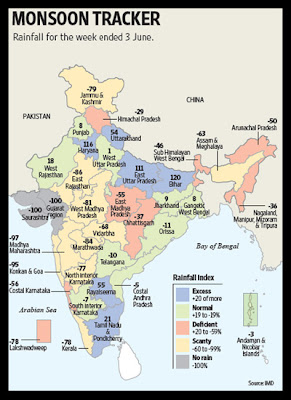
World Meterological organization warns of greater than average chance of El Nino thus having profound impact on the Indian Monsoons. As it stands, the Indian Monsoon has barely progressed in the last two weeks (2nd/3rd week June).The annual June-September monsoon generates nearly 80% of the annual rainfall over the country and is vital for the economy, being the main source of water for agriculture, which accounts for around 17% of India’s gross domestic product (GDP). Other than the 60% of the country’s workforce that depends on agriculture, the rains are also important for traders dealing in food and cash crops.As of 17th June, the latest estimate shows a 45% shortfall in rainfall.28 out of 36 meterological sub divisions have recorded scanty rainfall as against 4 divisions last year. Read Could El Nino dry up the economy's green shoots? http://www.livemint.com/2009/06/08003141/Could-El-Nino-dry-up-the-econo.html?d=1

The Reason
A full fledged El Nino was only expected around August, commented Mr. Madhavan Rajeevan, meteorologist at ISRO.The only ray of hope is the fact that not all El Ninos are bad: 1997 El Nino led to excess rainfall. 2002 and 2004 El Ninos associated with severe droughts. However statistics favours El Ninos association with droughts: Between 1880 and 2006, 12 out of 18 El Ninos have corresponded with drought like conditions/below normal rainfall.


The Impact
Drought is the most eminent risk of the El Nino fall out with Khariff crops being at risk.Technically speaking a Rainfall deficiency of 10% or more is defined as a drought. Since, 55-60% of the Khariff crop is dependent on Monsoon, a small variation in the rainfall totals can impact the crop very adversely, There has been a drastic dip in water reservoir levels across several states. In nearly 80 national reservoirs, the water stored is 1/3rd less compared with the same time last year.and if not replenished during monsoons, irrigation water will be deficient, because drinking water needs would come first.

Long Term Damage and Control
The current year’s monsoon is considered to be crucial for the economy as buoyant rural consumption has been a key driver of growth amid an economic downturn (read http://www.livemint.com/2009/04/17234039/Monsoon-booster-for-rural-dema.html?d=1). While the country has sufficient food stocks to tide over any crisis this year, the macro economic pressure is expected to accrue on account of food price inflation.

In Orissa, Industries have been asked to cut down their production levels, because of low reservoir levels resulting in low electricity generation. Power deficit levels are expected to be 20 – 30%, even in a power surplus state like Orissa. Elsewhere in Chattisgarh, the Government has already purchased and stored 370,000 tonnes of rice and is ready to procure rice from outside as well. Madhya Pradesh is worst off in terms of reservoir crisis. Reservoirs which were full last year, are all running empty.

A shortfall in rainfall could also impact the power generation in the country. Agricultural demand for power would go up and power availability from hydroelectric projects would come down. This would impact the power supply position in the country.

Source: Truant rains could nix nascent recovery: http://www.livemint.com/2009/06/22235043/Truant-rains-could-nix-nascent.html?pg=1

Also Read: Changing Monsoon trends: http://www.livemint.com/2009/04/30222403/Changing-monsoon-trend-forces.html?d=1

http://www.livemint.com/2009/05/25092131/Monsoon-hits-Indian-coast-ear.html?d=1

Monday, June 22, 2009

Tongue in Cheek: What a waste!

A new section in Newspaper Posts, Tongue In Cheek, is about interesting facts and annecdotes concerning the world around us. Your comments as always are welcome.

Approximately 40% of the farm produce (Fruits and Vegetables) in India is wasted in the absence of organized cold chain network in the country.

Sunday, June 21, 2009

New Tools, new approaches

An excellent article reproduced from Mint's article on comparison on collaborative growth (Chinese approach) versus Inclusive growth (Indian Approach) by S Narayan (former finance secretary and economic adviser to the government).http://www.livemint.com/2009/06/21203159/New-tools-new-approaches.html?h=D

China is focusing on massive infrastructure investment--less than 40% of this is from its central budget

There is a quiet in the corridors of government, and people in the know attribute it to ministries getting down to serious work. There is evidence of cleaning up in several ministries, with changes in the higher echelons of bureaucracy and a revamp of the personal staff of some ministers. The Budget is only a couple of weeks away, and the big companies are making effective use of the media to lobby their requests for tax breaks and tariff reductions. There has been a very good article by Narayana Murthy of Infosys that recommends downplaying the Budget into a revenue-balancing exercise and focusing on deliverables and programmes.


The Prime Minister has made it clear that he wants growth back to double digits, and the good news is that inflation is also falling. There is sufficient liquidity in the system, and there are investors willing to back the equity markets. The poor monsoon is cause for worry, but many financial firms are upgrading India’s 2009 growth prospects.


Financial investment firms upgraded prospects for China as well, based on the financial stimulus packages announced by that government. China has just announced $20 billion loan assistance to Russia, clearly indicating its financial superiority. It is interesting to compare the policy approach for stimulus used by China with that in India. The (Chinese) approach followed has been to focus on a massive infrastructure investment programme of half a trillion dollars. Interestingly, less than 40% of this is from the Chinese central budget—the local governments have been asked to find the balance and to implement the programmes. Banks have been asked to lend to provincial governments for this purpose, and liquidity infusion into the economy is through credit for infrastructure projects. There is, thus, an incentive for provincial governments to take up and implement long-needed projects, and the financial wherewithal to do it. Implementation is monitored through a simple incentive—governors who do well will be rewarded in the party hierarchy; others will not. Among the more important programmes is environment—cleaning waterways, urban waste management and water supply.


Let us compare this with the policy pronouncements made in the President’s address and in the Prime Minister’s letter to his cabinet colleagues. The focus is on “inclusive growth” that would be achieved by extension of the National Rural Employment Guarantee (NREG) programme, an Act to mandate food security—an extension of the NREG programme to urban areas, and liquidity infusion is through bank lending for the private sector and directed lending for agriculture. In short, while increases in liquidity are being targeted in China for the construction of infrastructure and the provision of improved services to citizens, in India it is being used for social welfare programmes and assisting the private sector. We could have done what China is doing, as we have a huge publicly owned banking system, and a federal structure that can reach to state governments and all major cities. Just imagine the benefits if the government had announced a major infrastructure programme in every major town over a one-million population, and left it to the local bodies to implement it, within technical and quality parameters laid down nationally—we would have our cities cleaned up and liveable in five years!


In the rural sector as well, something different is possible rather than granting agricultural loans and writing them off, leaving the farmer no better off. In investment terms, when banks give an agricultural loan, they are “long” on the crop— volume and prices, until the crop is ready. This is a financial risk taken by banks without adequate cover, given the volatility of crop yields and prices and the vagaries of the monsoon. This is the real subprime that hits bank balance sheets and government finances year after year. It should be easy to provide instruments in the markets where this risk could be mitigated by a vibrant spot and futures market of products. If agricultural produce could be stored and quality tested, then the receipts become marketable, with assured delivery at the end of the contract. From this, it is easy to develop futures and options that will mitigate risk. In effect, the bank lending for agriculture can continue, and the market would mitigate the risks of this lending through price and volume discovery that is transparent. Farmers would be benefited through a clear price for their products, middlemen would disappear, bank risk would be mitigated, and government interventions avoided. All that is needed is to create state-specific exchanges where such transactions can take place under the state regulators (under the Agricultural Produce Marketing Committee Act), and encourage farmers to participate.


It is important to think of new approaches. The pattern of programmes outlined by the government is a revisit of the rural development and poverty alleviation programmes of the past several decades, without any attempt to learn from their failures or think in terms of the new, young, urbanizing population of today. The needs of the people, as well as their aspirations, have changed and perhaps we should use the new tools at our disposal in the financial and services sectors to deliver what the citizen expects.

Thursday, June 18, 2009

Are Infrastructural Shortages stiffling India

Two seemingly unrelated news articles in Mint today and yet the connect between both of these is mighty and huge.

The first one is about World Bank raising the its forecast for China’s economic growth from 6.5% to 7.2%. This was due to strong government investment supporting growth of the economy.

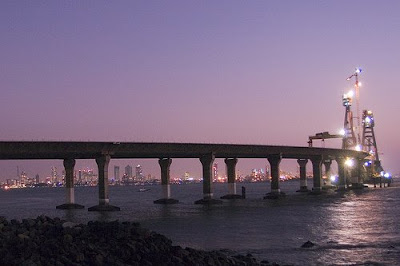
The second article was a report on the delays in Mumbai’s Bandra-Worli sea link. The project is being opened this month after a four year schedule delay.

Yours truly, had the opportunity to visit China early this month and the two things that impressed me about China were:
Infrastructure that is at-least 10 – 15 years ahead of India.
The investor and business friendly legislations. The scale of Industry and SEZs and the tax exemptions to the industry.
China had embarked on the journey of open market economic liberation 12 years before India had. However, what seems evident in China is the way they have managed the madness of trade and economic liberalization. They built roads and bridges and power stations and ports and aerodromes to handle growth. India went about all this in a pretty unstructured way vacillating between governments and politics. The result is obvious: China, the most populous state in the world, the third largest economy in the world grows fastest, while the Indian Juggernaut is still taking off.

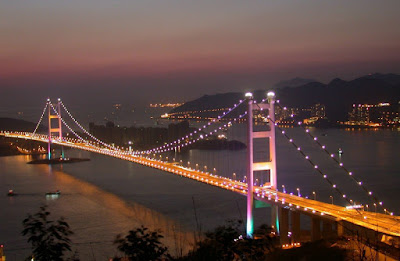
Hong-Kong Macau Sea Bridge

Bandra Worli Sea Link
The case in point is the Worli Bandra sea link. Conceived in 1990s, the 20 Kms Western Freeway project was designed to reduce the traffic choke on Mumbai road arterials as well as reduce the traveling time for commuters in the commercial hub of India. 8 years after the project had progressed, only half the number of lanes (4 out of 8) on a quarter of the actual length planned (5.6 out of 20 kms) is complete. That’s a project completion rate of 12.5% only in double the allotted time. Compare that with China, which has built 10 such sea links in 8 years. The Hong-Kong Macau sea bridge and the 32kms long Donghai bridge in Shanghai was completed in 3.5 years. The 43 Kms Hong Kong – Macau – GuangDong bridge will be built in 6 years.

Elsewhere in India, Delhi, the Metro Rail system is a better example of project management even though the same cannot be said for Common wealth preparation in Delhi.

Its time that all such projects are thoroughly examined by the state and centre governments and all and any causes of delay are penalized for incompetence. It is imperative that infrastructure projects are completed on time and schedule, for supporting the significant strides made by the Indian private sector.

Saturday, June 13, 2009

BJP Imploding (Part I): The lack of a Coherent Vision

Post Reference:
Bharat Karnad:professor at the Centre for Policy Research, New Delhi . http://www.livemint.com/2009/05/31212229/BJP-finding-the-right-centre.html
Ramesh Thakur: http://timesofindia.indiatimes.com/Opinion/Editorial/TOP-ARTICLE--Press-The-Reset-Button/articleshow/4600720.cms


Anti-incumbency, a nondescript track record in office and an insufficiently thought through nuclear deal should have drubbed the Congress in this general election. The botch-up by the opposition Bharatiya Janata Party (BJP) ended up increasing Congress’s margin in Parliament. But a larger truth lurks behind the BJP’s failure, beyond supposed lapses in electoral strategy and a misreading of the public mood. It even surpasses the little noticed irony of the Congress party acquiring a youthful sheen only because the dynast Rahul Gandhi hand-picked young men and women as candidates, something which L.K. Advani—heading a less autocratically run outfit—could not do. Its failures include lack of vision, leadership and strategy.

No Ideological Core apart from Hindutva / Lack of a coherent vision

That truth relates to the BJP’s having no ideological core. There is space for a centre-right national party alongside the Congress on the centre-left, around which politics can be structured and coalition governments formed. Instead of basing itself on any progress and development led idealogical core, BJP went alongwith Hindutva and Congress bashing as its electoral idealogy. After BJPs losses in the 6 state assembly elections (including Delhi), it was expected that BJP would reconsider its electoral USP and communication strategy. However, BJP clung on to its Hindutva platform and demeaning the Congress (instead of exulting its own agenda or achievements).

BJP's challenge was to preserve Hindutva loyalty and yet reach out to a broader social coalition. For the aam aadmi, Jai Shri Ram is increasingly passe. The BJP had a choice: Cling to the past the glory that was India with a shrinking voter base or embrace a vision for the future the glory that awaits India which appeals to the growing voter cohorts of the young and urban.

The Congress at least offered the solace of rhetoric, regardless of whether the condition of the “aam aadmi” (ordinary citizen) is ever bettered by the party’s exertions in power. Election slogans encapsulate the promised thrust of government. It does not matter if the end state is never reached. Recall Indira Gandhi’s “Garibi hatao” (End poverty)? It did little for the poor but kept the Congress party in clover for nearly a generation. In this context, faced with the BJP’s campaign, the average voter would have concluded that it was disconnected from reality.

Social order and stability were the preconditions for the rights and freedoms enjoyed by the citizenry as well as for a free market. It is these principles that the BJP should associate with.

Sunday, June 7, 2009

A better bureaucracy

In a separate post,some time back (http://newspaper-posts.blogspot.com/2009/01/thumbs-up-for-china-thumbs-down-for.html), i had discussed a point of view (widely accepted amongst Indian professionals), that while the growth of China is a result of their governance and bureaucratic efforts, Indian growth is more to do with the effort of individuals, businesses and entrepreneurs. A latest report ranks Indian Bureaucracy as being the worst in Asia. For long the accountability of the bureaucratic class has been a pain in India's governance.Reproducing an article by S. Narayan (former finance secretary and economic adviser to the primeminister) on the same issue.
http://www.livemint.com/2009/06/07212419/A-better-bureaucracy.html

With the reconstitution of the Planning Commission, the government has once again sent out signals that it means business. The new faces in the commission represent a class of people who have achieved considerable success in their own work environments, and who bring a passion to the roles they have been assigned. The President’s address to Parliament has underscored the determination to produce results, and there is evidence that ministries are being activated and some strategies worked out.
The air of expectation that things will happen this time is quite palpable, but one wonders what is different now. Improvements in levels of governance cannot come out of existing systems and deliveries, and yet there is little indication of how things will change. There have been no suggestions of reforms in processes and procedures: The reports of the Administrative Reforms Commission have offered little by way of solutions, and the major impediment to foreign direct investment (FDI) appears to be the excruciating pace at which the bureaucracy works.
Political and Economic Risk Consultancy, a Hong Kong-based organization, in its latest report has ranked India’s bureaucracy the worst in Asia, with a score of 9.45—zero being the best grade and 10 the worst. It is the only country whose ranking has worsened in the last three years. There are several reasons for this.
The first is ambiguity in policy. There are several examples. The foreign institutional investment (FII) policy, for example, allows free flow of funds without transparency of origin, for short-term investment into markets and market-related products, and has a low taxation burden in the form of capital gains tax. FDI has to bear the burden of full corporate taxation, as well as clearances from multiple agencies and continuous scrutiny. Poor mining policies and lack of consensus with states have stultified mineral exploitation, converting it into a resource available only to those with political access. However, most of these problems are in the realm of implementation issues, and can be addressed by ministers who are determined to get matters moving at their ministries.
The second is in the area of implementation strategies and monitoring. In the last five years, there have been several expert committees whose reports (nearly 70 in number) are available with the government, representing suggestions for implementation in areas as wide-ranging as agriculture and skill development: These only need effective implementation at the ministry level, this at the level of secretaries and joint secretaries. There has been almost no attempt to get these recommendations off the ground.
The third is the most difficult. This is in the area in which the public interfaces with the government, in the day-to-day business of life. In the area of sales tax and income tax, in paying bills and getting planning permissions, in running hospitals and schools, the functionaries of the government behave as though they are an Inquisition to extract the most from clients. This cutting edge bureaucracy, the reluctance at the lower levels of government to change, the lack of responsibility and accountability are all states of governance that we have wished upon ourselves.
Part of the problem is probably the scales of pay, but this has been substantially taken care of after the Sixth Pay Commission. More importantly, it has to do with how government servants perceive themselves and how society perceives them. They are part of the elite; and part of the way they display their importance is by being difficult to work with—whether in matters requiring their approval or when dealing with the people they meet. One reason could be the lack of checks and balances—as was demonstrated last week by the inspection of the Sushruta Trauma Centre in Delhi by the health secretary. But this is not all. The real problem arises from the hierarchical nature of decision-taking and the intense fear of taking the wrong decision, resulting in the tendency to pass the buck upwards. From the civil servant’s perspective, it is ideal to hide a decision behind a committee. In India, over the years this has gotten worse—decisions we used to take at the level of joint secretaries now require cabinet approval, that too after a formal recommendation by the committee of secretaries.
The Right to Information (RTI) Act and public interest litigation (PIL) have no doubt contributed to transparency in decisions, but they have also increased the reluctance to take decisions at lower levels. The answer is “no” unless there is no way of avoiding a “yes”—and corruption flourishes in such an atmosphere.
There are no easy solutions here. One way is to distance people from the bureaucracy through technology—payment of bills, tickets for travel, and applications for jobs and admissions can now be done without face-to-face contact. There should be an attempt to enhance these services. However, at the level of approvals for economic activity, improvements can only happen if those at the top are more vigilant—through better supervision and checks and, most importantly, speedy deterrents.
We need to change the way government transacts its business.

Wednesday, February 18, 2009

6000 crores: Cost of running the Largest democracy in the world

Seven days back, i had put in my first post on the election expenditure in India. http://newspaper-posts.blogspot.com/2009/02/elections-in-india-financial-black-box.html
I feel compelled to revisit the the topic again basis a times of India report on election expenses. http://economictimes.indiatimes.com/News/Economy/Finance/Coming-Rs-6000-crore-poll-stimulus/rssarticleshow/4146923.cms

This ToI report by Akshaya Mukul and Sanjaya Dutta tries estimating the lowerside of the costs of a general election in India. The starting premise is Rs.1300 crores (equal to 2004s spends) on getting the infrastructure and machinery running. (I had estimated this to be Rs.2000 crores)

On a very basic assumption that all 543 constituencies will have a triangular contest, the model estimates 543*3*2 = Rs.3258 crores of money spent by candidates on their campaigns. It is worth a mention that the average spend by a candidate has been fixed at Rs.2 crore. This doesnot include upsides like city candidates spending more, or, more than 3 candidates in the fray. Also the campaigns are getting the technology edge i.e SMSs, Websites, Web Banners etc. These costs have been overlooked because compared to all other traditional means and methods, these would really be a very small percentage.

Then there are the party propaganda costs. This is over and above the candidate spends at constituencies and they drive the party objective (e.g Bharat Nirman, LKAdvani.com etc). This doesnot stop at BJP and Congress. SP, BSP, BJD,RJD, DMK, TDP, NCP, JDU, CPM and many other will incur spends. These figures are difficult to ascertain. Alone Congress had declared Rs.125 crore spends and BJP had declared Rs.42 crore spends in 2004. We can assume a figure of Rs.750 crore as a cummulative of propaganda costs of all party which by all means would again be extremely conservative. (We already have BJP spending Rs.250 crore in its "L K Advani as prime minister" campaign).

Then a ball parkish Rs.250 cores (again on lower side) can be parked for donations from friends and benefactors of the candidates.

Thus we have 1300 crores (estimate of 2004) + 3258 (Spends by candidates) + 750 crores (Spends by parties) + 250 crores (donations) ~ Rs. 6000 corore riding on teh elections. A more realstic figure would be Rs.7500 crore. In a year , when 2 stimulus packages have failed to revive economic growth, and a pessimistic view of fiscal deficit puts it at 10% of GDP (Planned at 6%), Rs. 6000 crore appears to be a very high price to pay for making choices (one not any better than the other).

However, that i presume is the cost of running the largest democracy in the world ~ rs.6000 crore in the election year (recession or no recession!). The minimum we do is to vote!

Monday, November 24, 2008

Hope in the horizon, obstacles in the vicinity (Part I)

Historic changes in the world order have more been the outcomes of events such as the World Wars, Cold War, Atom Bomb, Iraq Conflict,9/11, Taliban, Serbia - Croatia etc. The uprising thats shaken the world this year is not as violent as any of the earlier events. However, the change ushered will be as dramatic or more. Yes, we are talking of the Financial crisis which has made headlines through the second half of the year and from the looks of it will be visible through a large part of 2009. Many of the western economies are under seize and there is a domino toppling effect is being felt world over from Australia to Africa. The reaction predictably is that of disbelief, shock, awe and despair. Billions have been lost to stock exchange crashes, industries are fumbling on bankruptcy, Retrenchment and job cuts are regulars on news headlines and economies are in doldrums.

Many governments world wide are giving of special packages to industries and banking sectors to support them collapsing. Economists and politicians are divided on opinion as to how to overcome the crisis. A $700 billion aid sanctioned by US treasury has been follwed by largeese by other government treasuries (predominantly the Europeans). In the deep dark hour, two economies, that of India and China are being looked at with some hope. While Recesseion cannot be ruled out given the global nature of trade and forex inflows and outflows, these economies are some what insulated from the spine breaking consequences. True that they have their share of problems in terms of Inflation, Infrastructure and others, but their ascendance to higher pedestals and status in the world economy is unmistakable.

From an Indian Stand point, China is far ahead of India in economy terms. The Dragon has started flying even while the tiger takes baby steps forward. However, the walking tiger is also huge encouragement.

However a few things that India needs to address (and is addressing it as well)

1. India's ascendance has been lopsided in terms of service economy. Software and brainware is where India scores higher than China.

2. Manufacturing, however has not been India's forte. That is where China whacks us and most of the westernized economies of the world.

3. There are improvements in the Agricultural sector, but the pace is frustratingly slow.

I appreciate the Government's efforts in terms of supporting Infrastructure. The basics of roads, railroads, electricity and sanitation needs to be in place as early as possible. Sadly our improvement in these aspects has been much behind schedule. "Bharat Nirman" (see pic), a congress project has been a failure due to lack of political willingness and corruption. Irrigation and health services have improved but the gap between India and other nations (Even African nations) is woeful. According to a study in the year 2000, Israel had 100 times less arable land than India and its produce was 10 times more in terms of yield. Similarly, according to a recent article, manufacturing units in Tax haven Tamil Nadu are operating lesser shifts not because shortage in demand but because of inadequacy in power supply.

Development Areas & Metrics Target (2005 - 2009)/Achievement (2005- 2008)

Irrigation (Area in Million Hectares) 10/5 (50% achieved)

Drinking Water (No of Habitations) 603639/385353 (64% achieved)

Roads (No of Habitations Covered) 66802/20871 (31% achieved)

Roads (Upgrade & New Connectivity) 340316/146905 (43% Achieved)

Housing (Houses in Millions) 6/5.04 (84% achieved)

Electrification (No of Villages) 125000/48176 (39% achieved)

BPL Households 23/2.29 (10% achieved)

Telephone Connectivity (No of Villages) 66822/51973 (78% achieved)

(to be continued)