Showing posts with label Economy. Show all posts

Tuesday, August 25, 2009

The virtues of a good drought!


It is now official. We are in the middle of the worst drought since independence.Ten states have declared 246 districts as drought hit. This is about 47% of the total districts in the country.Rice production is also expected to go down by 10 million tones. However India does have enough food reserves to meet any shortfall for the next 13 months. The fall in rice production works out to as much as 70% of what the country holds as buffer or emergency stock. Foodgrain demand for 2008-09 has been estimated at 219.01 million tones as against 233.88 million tonnes produced. India currently needs 7.2 million tones of Rice as buffer and has about 14.1 million tones. The current buffer for wheat is 7 million tones while the country has 15 million tones. This will help the country avoid the need to import. Congress party spokesman Janardhan Reddy has issued an advisory to the government to tackle the most important fall out of a drought season: the rise in food prices. Already, Congress has drafted a “drought-code” for its members, whereby Congress MPs, legislators and salaried officeholders will contribute 20% of their basic salary to state and central exchequer in a symbolic gesture of solidarity with those battling drought and price rise.


To a certain extent, the concerns about its impact on growth are valid but less so compared to the previous droughts: partly because agriculture accounts for much less of national income now than it did during previous droughts and partly because other sectors of the economy are less dependent on agriculture than they were earlier. The concerns are valid but are not as important for growth as they are for livelihood and food security, since at least half of India’s population still depends on agriculture for its livelihood and that is not much different from previous spells of drought.


This drought is a grim reminder of the fact that not all of boom in agriculture was driven by government policy. It is an altogether different matter that the rain gods hardly ever get credit for good monsoons. However, droughts have also presented the unique opportunity to governances in their time to innovate social solutions. Earlier droughts have now become landmark events for public policy depending on a government’s ability to convert challenges into opportunities.


The first major drought after independence was in the mid-1960s, with severe consequences for food security. But the government of the day was successful in converting the challenge into a golden opportunity. The opportunity was the green revolution and by the end of the next decade we were more or less self-sufficient in food. It was also successful in increasing irrigation on a much bigger scale than in the previous decades.


The second major public policy lesson was also a response to droughts. The much-appreciated National Rural Employment Guarantee Act (NREGA) is a successor of such a policy initiative. It was the Maharashtra Employment Guarantee Scheme which was started initially as a drought relief programme that formed the basis of a unique experiment in the world to provide guaranteed employment to the rural poor.


The importance of public employment programmes was also appreciated in the 1987-88 drought, which incidentally also saw a significant reduction in rural poverty for the first time. This was ably supported by the public policy of keeping cereal prices low and providing food security to the poor.


The 2002-03 drought was again severe and manifested itself in large-scale farmer suicides, but it also exposed the limitations of credit delivery in rural areas. The rapid expansion of credit in rural areas subsequently has not been enough to correct the serious imbalances on that front but it was successful in emphasising the magnitude of the problem. But more than that, it did provide the background for emphasising the importance of public employment programmes. The result is NREGA.


So what kind of opportunity does this drought throw up? In the long run, this drought has highlighted the vulnerabilities of Indian agriculture to the seasonal monsoons, despite claims of record production in the last four years. There cannot be a better time to usher a second green revolution and create a sustainable food security environment. It is high time to take up the long-term challenge of investing in agriculture and particularly on creating long-term sustainable irrigation systems. These may not be large-scale irrigation systems alone but even small water harvesting and conservation works undertaken as part of NREGA. But, in the short run, it is the best time to strengthen NREGA and expand its scope to individual entitlement from the existing household entitlement.


This drought is also a golden opportunity to convert this challenge into a successful public policy initiative. This opportunity is the enactment of the Right to Food Act. There cannot be a better time to do this. There is already a political consensus. This is also the time when the government stocks are full of foodgrain and it is economically insulated because of high growth achieved in the previous four years. This government has the option of being remembered for having faced the worst drought since independence or being remembered for successfully fighting it by enacting the Right to Food Act.
Ref: http://www.livemint.com/2009/08/18234120/It8217s-time-for-a-New-Deal.html

Sunday, July 19, 2009

Now is the time for Economics 2.0.

Economics, the way we know it must change. For 200 years and more after Adam Smith propounded the first theories of Economics, there may be a need to look beyond them. For the last 2 centuries, Economics as a science has been used to describe effort, need, productivity and transactions both at an individual and a national/global scale and this is still gaining relevance. Economic indicators have also often been the benchmark to imply societal development. It is not uncommon that a nation with higher per capita income is more developed and prosperous or the largest GDP states are the most advanced. However, in view of a few more variables today, the meanings of human/social development have become more complex than the economic constructs.

Two most important variables apart from transactional economics are:
· Effect of Climate change
· Holistic societal development

Economics discounts Climate and Environmental Factors
Widespread environmental changes will significantly alter the course of human history going forward. These changes pose clear and present danger in front of the states, citizens and their economies. Emissions and pollutant discharge are a direct function of the level of industrialization of economies. While it isn’t possible switching off the growth engines of the economy, the switch-over to environmentally safe and renewable energy sources will take another 20/30 years to take shape and have an impact. Reducing Carbon footprint is till now a very low scale exercise. Over and above this, is the debate on reduction of emissions in developed versus developing states.

Developmental economics or the present indices do not measure the impact of growth on environmental resources. Thus, the growth today can lead to environmental, climatic or socio economic risks tomorrow. The concept of GDP or economics based measurement is thus a failure in this regard.

Economics discounts parameters of Human and Societal development
Inequities within societies and states have existed forever in history, The current economics do not measure societal development parameters like pure water availability, food security, literacy and education, Infant Mortality rates and Child malnutrition and various other parameters. Economic development has been associated with resource exploitation. The best case in point is Oil, the lifeline of modern day economics.

The point of engaging economics, environment and human developmental issues is to hence build sustainability of progress and spread the fruits of development amongst people and states. There is a need to radically rethink Economics to address these grave issues.

Monday, June 29, 2009

India: A worrisome fiscal situation

A very important part of populist measures of the incumbent government is to provide equal earning and job opportunities to all. Towards this, the National Rural Employment guarantee scheme (NREGS) is a tool for equitable employment and pay disbursals. However a bad monsoon can turn this tool into a fiscal nightmare. A bad monsoon will ensure that the number of people seeking jobs under NREGS will swell. Being an entitlement based programme, the government has to give employment to anyone who demands it. Recently it announced that a further Rs.9000 crore would be spent under NREGS, taking the total expected spending under it in fiscal 2009 to Rs.39000 crore. That was when the effect of Monsoons were not taken into consideration. With this new exigency in horizon, the NREGS spends may be spiraling out of control. A substantial portion of the fiscal deficit was due to budgeting of expenditures for farm loan waivers and expenditure under NREGS.

Already the economic slowdown and the threat of fiscal deficit hitting the double digits is likely to limit the UPA government from unleashing it full deck of “Aam Aadmi” agenda. Increasing the budgetary spending is only possible when the economy recovers on the path to 8 – 9% growth rate.

In February, the government had set a fiscal deficit target of 5.5% of GDP for 2009-10 but increased its borrowing target to Rs.3.62 trillion from Rs.3.05 trillion last year.
In the first month of the fiscal year, the government already achieved 16% of its fiscal deficit target. The reduction in excise tax by 6% as a part of stimulus package and the Food Security act (which provides food-grains @ Rs.3 per KG to below poverty line beneficiaries) is expected to hit the state coffers.With an expected shortfall of Rs.26000 crore in tax collections and an increased expenditure of Rs.24000 crores (Not counting in the impact of late Monsoons), the Fiscal deficit may be grim, very grim.

Tongue in Cheek:Global loss in wealth due to Financial Meltdown

The world wealth report (June 2009) released by Merrill Lynch and Capgemini estimates a damage of $8 trillion (Rs. 388 trillion) due to the financial meltdown of the world economy in 2008.

Friday, June 26, 2009

India and China: Growth Construct


The return of global liquidity is a welcome sign in the recession and downturn strife economies of the world. Amidst the recoveries, India and China have been the earlier ones (alongside Russia and Brazil). The economy growth patterns and road maps of both the economies have been diametrically opposite. While China’s growth has been a function of the demand in consumer markets in the west and its export surplus, the Indian market is domestic demand led. The liquidity crisis affected both these economies in different manners: For China it reduced the export demand and for India, it reduced the external funding and investments.

Two interesting studies, one by Morgan Stanley and the other by World Bank seem to indicate the return of liquidity will benefit India more than China as India and China will pare off in growth rates with India nudging ahead of China.
Even more interesting is Morgan Stanley’s prediction of annual GDP growth for the period 2011-15. While India’s GDP growth under the baseline scenario during these years is predicted to be 7.5% per annum, China’s too is pegged at 7.5%. Similarly, under the bullish scenario, both Indian and Chinese growth during 2011-15 is forecast to be 9% per annum. But in the bear scenario, India is expected to do even better than China, growing at 6.3% compared with China’s 6%.

Even the world bank in a report released on 22nd June ,2009 forecasts that India’s GDP growth in 2010, at 8%, will be higher than China’s growth rate of 7.5% that year. Further, in 2011, both India and China are expected to grow at the same 8.5% rate.

The Tiger is for the first time looking to outrun the Dragon. So, what could be the reason of the Indian Surge/Chinese Slowdown?

China is more exposed to the vagaries of the world market because of its high trade intensity. A Japan style secular slowdown in the US and Europe over the next decade will hurt China more than India unless China moved beyond its admittedly successful mercantilism.
The FDI boom in China since the mid 90s pushed its investment rate, enabled technology transfer and plugged the nation into global supply chains. All this took China closer to the global efficiency frontier, but it now seems that diminishing returns are setting in.
Future growth in China will have to depend on domestic demand and local innovation, which means China will have to change its growth model.
The fast ageing Chinese society will increase the dependency ratios and social costs.
Concern arises from the fact that growth in China will taper off once the push from the Chinese stimulus package runs out of steam and its loan push slow.(In the chart, China’s GDP growth spurts in initial quarters as the result of the stimulus but decelerates as the effect dissipates)
Cost based Chinese manufacturing may be over-rated. Albert Edwards, global strategist  at  Societe Generale, writes: “Most areas in the markets have now discounted a V-shaped recovery. Any doubt will trigger a rapid reversal in prices. I continue to be extremely sceptical and see recent events as part of a 1930s-like long march to revulsion. Talking about long marches, nowhere in the world fills me with more scepticism than the Chinese economic recovery. The continued enthusiasm for all things Chinese reminds me so much of the way investors were almost totally blind to the fact that the US growth miracle was built on sand. China could be the biggest disappointment yet.”

The challenges that both these economies will stand up to fuel their growth stories are again very diverse:
For China, it will be a transition to domestic led growth
For India, it is going to be building infrastructure and its fiscal woes (owing to a bad governance and the quality of national leadership)
Reference:
Catching up with China on Fast Growth Track:
Can India run ahead of China

Tuesday, June 23, 2009

Will Monsoons spook Economic Growth away?

The biggest driver of Indian Economy numbers through the downturn was a bouyant domestic demand. This helped it tide over the economic doom better than most of the countries around the world. However, the spectre of a bad monsoon actually is more insidious to the Indian economy than anything else. And this is one threat the Indian economy is somewhat less prepared to coast over.
The crisis
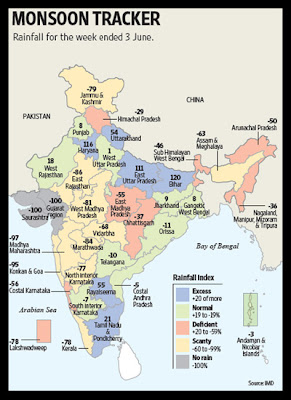
World Meterological organization warns of greater than average chance of El Nino thus having profound impact on the Indian Monsoons. As it stands, the Indian Monsoon has barely progressed in the last two weeks (2nd/3rd week June).The annual June-September monsoon generates nearly 80% of the annual rainfall over the country and is vital for the economy, being the main source of water for agriculture, which accounts for around 17% of India’s gross domestic product (GDP). Other than the 60% of the country’s workforce that depends on agriculture, the rains are also important for traders dealing in food and cash crops.As of 17th June, the latest estimate shows a 45% shortfall in rainfall.28 out of 36 meterological sub divisions have recorded scanty rainfall as against 4 divisions last year. Read Could El Nino dry up the economy's green shoots? http://www.livemint.com/2009/06/08003141/Could-El-Nino-dry-up-the-econo.html?d=1

The Reason
A full fledged El Nino was only expected around August, commented Mr. Madhavan Rajeevan, meteorologist at ISRO.The only ray of hope is the fact that not all El Ninos are bad: 1997 El Nino led to excess rainfall. 2002 and 2004 El Ninos associated with severe droughts. However statistics favours El Ninos association with droughts: Between 1880 and 2006, 12 out of 18 El Ninos have corresponded with drought like conditions/below normal rainfall.


The Impact
Drought is the most eminent risk of the El Nino fall out with Khariff crops being at risk.Technically speaking a Rainfall deficiency of 10% or more is defined as a drought. Since, 55-60% of the Khariff crop is dependent on Monsoon, a small variation in the rainfall totals can impact the crop very adversely, There has been a drastic dip in water reservoir levels across several states. In nearly 80 national reservoirs, the water stored is 1/3rd less compared with the same time last year.and if not replenished during monsoons, irrigation water will be deficient, because drinking water needs would come first.

Long Term Damage and Control
The current year’s monsoon is considered to be crucial for the economy as buoyant rural consumption has been a key driver of growth amid an economic downturn (read http://www.livemint.com/2009/04/17234039/Monsoon-booster-for-rural-dema.html?d=1). While the country has sufficient food stocks to tide over any crisis this year, the macro economic pressure is expected to accrue on account of food price inflation.

In Orissa, Industries have been asked to cut down their production levels, because of low reservoir levels resulting in low electricity generation. Power deficit levels are expected to be 20 – 30%, even in a power surplus state like Orissa. Elsewhere in Chattisgarh, the Government has already purchased and stored 370,000 tonnes of rice and is ready to procure rice from outside as well. Madhya Pradesh is worst off in terms of reservoir crisis. Reservoirs which were full last year, are all running empty.

A shortfall in rainfall could also impact the power generation in the country. Agricultural demand for power would go up and power availability from hydroelectric projects would come down. This would impact the power supply position in the country.

Source: Truant rains could nix nascent recovery: http://www.livemint.com/2009/06/22235043/Truant-rains-could-nix-nascent.html?pg=1

Also Read: Changing Monsoon trends: http://www.livemint.com/2009/04/30222403/Changing-monsoon-trend-forces.html?d=1

http://www.livemint.com/2009/05/25092131/Monsoon-hits-Indian-coast-ear.html?d=1

Tuesday, February 10, 2009

Of Economy, Environment and Human Development: Failure of the GDP concept!

Gross Domestic product (GDP) as a progress indicator/paradigm was a part of the post 1940s era world reconstruction. Over the last 70 years GDP has become a construct for mesauring guman progress and all economic policy making is directed squarely at increasing/maximizing GDP! GDP as a part of national accounts was created by Richard Stone and James Meade with support from John Maynard Keynes as a means to keep track of the economic activity in a state.

However, the challenges faced by the world have now grown from economic/financial to environmental in nature. Then there are challenges on the human development side of things as well. Unfortunately, both the environment and the socio demographic human state is not measured as a indictator of progress. For example, the rich oil producing countries in middle east are the richest in nature and yet most parts of it have people living in the 17th century with no access to basic amenities. Likewise, China is a model for economic growth and yet its Human rights index and environment development index is amongst the poorest!

Interestingly Richard Stone, in his Nobel Memorial Speech in 1984 had himself stated that apart from economic growth, the analysis of a society's progress has to be based on socio demographic as well as the environmental phenoma. To be quoted "...environmental issues, such as poluution, land use and non renewable resources offer plenty of scope for accounting". Unfortunately, the world has continued to pay attention to the economic activity side stepping the environmental and human issues.

Given the socio demographic and environmental issues faced, the world today needs to create additional metrices such as Human Developmental Index and Carbon Footprint. There is a possibility that three metrics may not be preffered, in which case GDP has to be recaliberated to reflect genuine values to things like air and water pollution, deforestation, land degradation, use of alternate energies, health, education, crime etc. The result would be a new GDP number that would truely reflect value generated/consumed by human activities. A striking instance of how the new GDP calliberation would affect the old GDP system is the case of Uttar Pradesh. In just accounting for water quality in rivers in UP, 17.5% of the old GDP would be reduced! Imagine China going from a 11% GDP growth economy to 3% economy GDP growth economy because of the heavy inductrial pollution and bad human development indicators! US would go negative by two digit decimals!

What this would also mean is viability studies that are more rounded. For instance the economic surplus because of a new dam could get negated fully and more by the deficit in the ecological shifts and change in population demographics! That would provide an excellent allround development metric. It is time to move towarsd this sooner!

Tuesday, January 20, 2009

Thumbs up for China, Thumbs down for India


I start this blog with 2 widely believed and unproven hypothesis. You would probably get to hear them more in the corporate boardrooms specially MNCs which have invested and done business with India.

Hyp. 1: India discounts it GDP growth by 2% on account of infrastructure unavailability. Whether be the lack of proper roads, or electricity, or governance, or airport infrastructure or just the red tapism in the bureaucracy. It is a significant deterant to the global super power dreams of India.

Hyp 2: India's growth has been powered more by its educated citizenry with government being a by stander in the growth. If any thing, the neta giri and the babu-dom have shackled the Indian executives and business more than giving them head room and leg room to grow. Mani Ratnam's Guru, had a 4 minute monologue by Abhishek Bachchan on the fetters that governance is putting over capitalism in this country.

India ranks a lowly 122 amongst 181 economies in terms of "ease to do business index", a reportpublished by the world bank group. Only African nations and war torn economies are more difficlut than India in terms of ease to do business! So much so for an economy whihc is the second fastest in the world in terms of growth.

Vodafone’s global CEO Vittorio Colao made his point clear in the CII conference on 19th January 2009, that India must offer increased clarity on its foreign direct investment across sectors. The(FDI) policy in India is complex and lends to multiple interpretations. Companies work on their legal interpretation of the policy and sometimes, find that they have tripped onto the illegal side of things as per policy.
What ever interpretation we give to the Indo - China ascendancy, whether be the tiger or the elephant and the dragon; policy makers in India should understand this clearly as anything else, we are in the competition of global investment. Better products, better services, better jobs are only possible if, suitable climate is provided to businesses to perform. As a first hand, i am aware of the "gifts" that lobbies and corporates bestow on the Babus in the state and union to see that the businesses continue unhindered. Bribes form a part of the deal, right from the CEOs office to the ground of action where the municipal clerks and the policemen are "taken care of". I was not wonder struck, when one of these opinion polls revealed that Indian corporates are least averse to paying bribes for smooth functioning of their operations.

Even China is state controlled to a very large extent. However, the difference is stark. The Dragon's speed, growth and efficiency is a product of the state governance. It is top down , while for India it is bottom up. Without a doubt, in the long run, a bottom up is more beneficial. However, in the present circumstances, it is dragging the resurgence down below.

In an earlier blog, i had mentioned, 2009 being the election year will mean a plethora of populist measures. The exchequer is going to bleed and the onus for making up on the losses will be laid squarely on the shoulders of corporate India. Already, i believe that the upward revision of 3G licensing fees from Rs.1650 crore to Rs.4040 crore makes it a untenable option for business houses. Unviability will lead to slower roll outs impacting services standards in the country. But really, does any one care?

Thursday, December 18, 2008

Now is the Time for Barrack Obama


Over most of 2008, i watched Barrack Hussein Obama overcome herculean odds to become the next president of United States. To me the preliminaries where he fought Hillary Clinton were a greater test of the person than the actual Democrats versus Republicans election against John McCain. For most of the part, Obama never faltered with his message of change must come to America. John McCain's choice of his deputy, the pin up Sarah Palin, was a significant cause of his defeat.


However, this blog does-not deal with that. It deals with Obama, the successor of Bush. For 6 and a half years, Bush was a buffoon on the most important seat in the world. As the president of US, Bush actions were not only jibbed, laughed at, cartooned and caricatured; the enormity of his policies and mistakes have made the world a whole lot more unsafe then it was before. A failed War of Terrorism which saw him burn up trillions without any effect, a domestic economy reeling under the financial crisis, the fall of the wall street and the big american firms, failed agreements: there is precious little to show on his result card, as Bush bows out. I would assume that in the history of American presidency Bush was the most lampooned president ever (not withstanding the Media multiplication). Little wonder then that George W Bush, the 43rd President of America ends his term in a manner of a lame duck with a fitting tribute to his 8 years at the oval office, a size 10 boot. (From Iraq with love). The world lays seize to very real threats such as climate change, terror and a long depression. Mr Bush retires with a next to zero score on his report card. His eccentricities and funny ways have not helped his cause and reputation either. Love to see this comic strip called Bush in Big Brother or something.

At this time, the world and the american citizenry looks upto Obama with hope and encouragement. They see him to be an agent of Change, a politically savvy, self aware and intelligent spokesperson. One that the world needs so badly at this time. Apart from his persona, Obama has won hearst and minds with his actions. I singularly find, the appointment of Hillary Clinton to his team as a masterstroke. Hillary is too good an administrator to miss in any team that roots for change. Her inclusion into the cabinet signals that Obama means business and if that means teaming up with his arch nemesis to lead US out of the woods, he wouldnot bauly at it. (I wish the Indian politicians learnt a few things from Obama). As Obama prepares to take over the white house, he has a manifold agenda which includes putting some order back to the mess Bush is leaving behind and activating an agenda which propels change for better. Obama faces a stiff challenge in many and more fronts...
1. Leading the US out of the economic mess that it is. From being a recession that is worst in the last 80 years to a real time deflation threat. Obama and the Fed will have to look at means and measures to put the super economy of US back to the wheels.
2. The Big three are going under. The Fannie Mae, Freddie Mac, Meryll Lynch, AIG, Citigroup and many more are on Fed respirators. It is going to be a tough bullet to bite as Obama would presides over "how to overhaul the economy?". This has very powerful implications on the way people are going to see him in US as well around the world.
3. Climate is one of the most important issues facing the world. The tussle between the developed and underdeveloped world over Carbon emissions are going to be another critical test for Obama. How would he balance that?
4. The power centres in the world are shifting to China and India, both emerging strong and fast. How does US react and recognise these new kids on the block?
5. Terror is a real threat looming large. How would US handle delicate situations like the Afghan - Pak - India conflict / dilemna. Currently US is playing the peace monger but the relevance of the new kids along with the terror situation is going to be formidable challenge.
6. US has messed up in Iraq and it looks like it is following course in Afghanistan. Will there be a significant chnage in the American way of dealing with Terror now on? Its Obama's turn to decide.

Obama's aura is formidable (being the Time's man of the year)... the challenges presented are going to test every nerve in Obama as he takes over. It is scary to think but media and people over the world over rate this man... is he the Messiah he is supposed to be?

Why wont Pakistan make it as a nation (PartII)


An interesting article on Business Week about the state of Pakistan. This further extends my initial blog on Pakistan http://www.businessweek.com/globalbiz/content/oct2008/gb20081020_947596.htm#readerComments


Pakistan's Economic Crisis

•Even though Pakistan's financial crisis isn't directly linked to Wall Street's credit crunch or to subprime mortgages, the country's leaders seem confident that Pakistan will get its own bailout. President Asif Ali Zardari has spent the last month mending fences with India and playing nice with Washington. Zardari is now in China, where he will ask for a soft loan of as much as $1.5 billion. Why is he so confident Pakistan will get the money, when only recently Iceland had to go begging to Russia? Here are the reasons.

War on Terror

Effective or not, Pakistan is the U.S.'s closest ally in the war on terror. Since 2001, the U.S. has given Pakistan nearly $10 billion in military aid and has taken a keen interest in maintaining some semblance of stability in Islamabad. Even if the U.S. is not in a position to hand over cash right away, it wields influence with Pakistan's creditors and over such common allies as Saudi Arabia

Nuclear Weapons Power

As long as Pakistan possesses nuclear weapons, it is unlikely that foreign governments will allow serious political or economic upheavals that could undermine control of those weapons. There's little danger of Pakistan selling weapons technology for foreign exchange (though this has happened in the past), but a weak central government is worrisome.


Foreign Investors

The Karachi Stock Exchange is barely functional, with onerous limits and artificial price props. But for most of the first half of 2008, it was one of the world's few moderately sized markets that seemed immune from the subprime taint. Foreign investors rushed in, pushing the KSE up nearly 40% by midyear. Now they must wait alongside Karachi's irate small investors to extract their money.


The Friends of Pakistan

Later this month, Pakistan will hold a donor meeting in Abu Dhabi with an informal group called the Friends of Pakistan. There, President Zardari hopes Saudi Arabia will help deal with his country's oil import needs while other nations assist with its debts


China's Friendship
This week, Pakistan has a new friend—China, which Zardari is visiting for four days. With nearly $1.9 trillion in foreign exchange and a decade-long policy of supporting Pakistan as a counterweight to India, China might just prove itself to be the all-weather friend Zardari keeps calling it.

Pakistan on the Brink


Last week, Pakistan's credit rating slipped to second worst in the world, just a step above that of Seychelles. With less than a month and a half of foreign exchange reserves and no more than 10 days of oil supplies at hand (down from 21 days earlier this year), Pakistan truly stands at the brink of bankruptcy.

Foreign lenders

If Pakistan opts to default, creditors stand to lose huge sums at a time when lending markets are already in cardiac arrest.

Wednesday, December 17, 2008

Why wont Pakistan make it as a nation?


(I had written this article around October 2nd, 2008 on a vacation. Had not been able to publish it for reasons of connectivity)

The reasons for failure of Pakistan as a nation state. ( At this time, i have genuine doubts whether Pakistan has a future as a political entity.)

1. Born out of a significant "anti India" stance, Pakistan as a state has focussed more and most on its defence and military overtures. It really never had an agenda in development as a nation except India bashing. 6 decades later, Pakistan as a society is impoverished, undernourished and under-developed with no signs of looking better in the future.
2:It was an American ally (during cold war), a Taliban ally (during Afghanistan- Russia conflict) , a Chinese ally, an Azad Kashmir proponent, a Nuclear power, an Al Qaeda base and many more. Pakistan army, its defence forces and its secret service, ISI have held its governance ransom to their demands in many ocassions. Military expenditure as a part of the total National GDP in Pakistan has been extremely high because of the war and arms-idealogy that was in the fore-front of the national interests.
3: Its fledgeling democracy never really got going in real terms. In its history from 1947 till date, the prime ministers office was occupied for 32 years, which is about 50% of the total time. The other 50% of the time, the country had been run under presidential rule or martial law.
4: Since as far as i remember, Pakistani economy has only survived off US and world bank aid. There is zero foriegn investment in the country and reliance on international creditors for hard currency inflows has been on the upswing mostly through the decade.
5: With no real social economic development, the citizenry has plunged into destitution and poverty. The poor human development indicators support this arguement. Thus they have taken refuge in the arms of what we call "radical Islam": The idealogical birthground of terrorism.
6: With the military and ISI who were hand in hand with the terror organizations in India, Bangladesh and Afghanistan, this decade's "American war of Terror" has been the cause of Pakistan's undoing.
7: Pakistan is now caught between a deadly cross fire. On one end is the anti terror American axis, which is the only support that Pakistan as an economy really has. On the other hand, Pakistan cannot wipe out its murky past where it has been and still is an active harbour for terrorists. The ISI Army nexus pledge themselves to the Jihad. US of A, the greatest anti thesis and the prime target of Jihad, is Pakistani economy's biggest aid provider.
8: If Pakistan is seen politically all over the globe as a state abetting terrorism, it risks sanctions and loss of support. Withdrawal of that support can plummet Pakistan into a civil war which its society can ill afford. Its social and economic structures are too delicate to be able to breathe without the US respirator.
9: Hardcore elements in the governance will ensure that any process that tries to move away from Radical Islam is quickly stubbed off. The 26/11 Mumbai Terror plot was followed by a very real "coup and military take over" scenario in Pakistan. How ever hard the extremists and supporters of Radical Islam support their faith, they cannot over look the US respirator thus bringing them to a dead lock.
10: Thus Pakistan is in a stalemate where its external relations with US and tottering economy wont let its internal factions act decisively in terms of taking over. On the other hand, these internal factions will not allow the friends of Pakistani Democracy (assume Asif Ali Zardari to be one of them) to do much against the war on terror (accept perhapos Lip service and token arrests).
11. Which ever way it is, the choice is between the devil and deep sea for Pakistan. Whether Asif Ali Zardari would like to accept it or not, Pakistan UN intervention to get hold of things in their country. The sooner the better for him for the way i see it for him, an assasination attempt is not too far off in the present scenario.

On a sign off note, there is this small caricature that i chanced upon in 2002, which really depicts the US - Pak - Al Qaeda - Terror nexus very aptly.

Friday, December 5, 2008

Low Cost Housing: The next step to beat housing crisis woes

In an earlier blog on September 4th 2008, i had made a few comments on the fact that many of the realty industry giants: DLF, Unitech, Hiranandani and many others have notable projects which are mostly HIG or MIG+ ones. These companies had not invested much in the economy housing projects or projects which would be less than 10 lakhs/ 450 - 800 square foot size. Read point no 6.7.8 in the blog: http://newspaper-posts.blogspot.com/2008_09_01_archive.html.

Three months later, now that the crushing reality of financial crisis and recession is rumbling the world economy, the first steps have now been taken by large realtors towards these economy housing schemes. http://news.in.msn.com/business/article.aspx?cp-documentid=1715713. Interestingly the reasons sighted for shifting focus from HIG and MIG+ housing is

1. Higher diversity in projects leading to better cash flows
2. Be a part of the Priority sector leding to allow banks refinance at concessional rates and fulfill norms of directing lending
3. The Government believes that low cost housing finance may a part of the solutions package to give the much needed fillip to the housing sector in India.