Showing posts with label China. Show all posts

Thursday, July 2, 2009

Tongue in Cheek: The Chinese Green Dam Parody

Green Dam Software
The be-all and end-all of Chinese internet censorship effort, is the Green Dam software.Green Dam software is intended to stamp out Internet pornography, and computer companies had originally been told that from Wednesday they had to bundle "Green Dam" with all personal computers heading to stores for sale.

However, the seriousness of the effort was lost, when the Green Dam barred popular cartoon Garfield, Johny Depp and other innocent images. The reason was attributed to the deep orange colour of the images, which is screened by the software (Due to similarity with Nudes). Interestingly once the filter is turned off on the computer, graphic sexual images can also be downloaded.

Friday, June 26, 2009

India and China: Growth Construct


The return of global liquidity is a welcome sign in the recession and downturn strife economies of the world. Amidst the recoveries, India and China have been the earlier ones (alongside Russia and Brazil). The economy growth patterns and road maps of both the economies have been diametrically opposite. While China’s growth has been a function of the demand in consumer markets in the west and its export surplus, the Indian market is domestic demand led. The liquidity crisis affected both these economies in different manners: For China it reduced the export demand and for India, it reduced the external funding and investments.

Two interesting studies, one by Morgan Stanley and the other by World Bank seem to indicate the return of liquidity will benefit India more than China as India and China will pare off in growth rates with India nudging ahead of China.
Even more interesting is Morgan Stanley’s prediction of annual GDP growth for the period 2011-15. While India’s GDP growth under the baseline scenario during these years is predicted to be 7.5% per annum, China’s too is pegged at 7.5%. Similarly, under the bullish scenario, both Indian and Chinese growth during 2011-15 is forecast to be 9% per annum. But in the bear scenario, India is expected to do even better than China, growing at 6.3% compared with China’s 6%.

Even the world bank in a report released on 22nd June ,2009 forecasts that India’s GDP growth in 2010, at 8%, will be higher than China’s growth rate of 7.5% that year. Further, in 2011, both India and China are expected to grow at the same 8.5% rate.

The Tiger is for the first time looking to outrun the Dragon. So, what could be the reason of the Indian Surge/Chinese Slowdown?

China is more exposed to the vagaries of the world market because of its high trade intensity. A Japan style secular slowdown in the US and Europe over the next decade will hurt China more than India unless China moved beyond its admittedly successful mercantilism.
The FDI boom in China since the mid 90s pushed its investment rate, enabled technology transfer and plugged the nation into global supply chains. All this took China closer to the global efficiency frontier, but it now seems that diminishing returns are setting in.
Future growth in China will have to depend on domestic demand and local innovation, which means China will have to change its growth model.
The fast ageing Chinese society will increase the dependency ratios and social costs.
Concern arises from the fact that growth in China will taper off once the push from the Chinese stimulus package runs out of steam and its loan push slow.(In the chart, China’s GDP growth spurts in initial quarters as the result of the stimulus but decelerates as the effect dissipates)
Cost based Chinese manufacturing may be over-rated. Albert Edwards, global strategist  at  Societe Generale, writes: “Most areas in the markets have now discounted a V-shaped recovery. Any doubt will trigger a rapid reversal in prices. I continue to be extremely sceptical and see recent events as part of a 1930s-like long march to revulsion. Talking about long marches, nowhere in the world fills me with more scepticism than the Chinese economic recovery. The continued enthusiasm for all things Chinese reminds me so much of the way investors were almost totally blind to the fact that the US growth miracle was built on sand. China could be the biggest disappointment yet.”

The challenges that both these economies will stand up to fuel their growth stories are again very diverse:
For China, it will be a transition to domestic led growth
For India, it is going to be building infrastructure and its fiscal woes (owing to a bad governance and the quality of national leadership)
Reference:
Catching up with China on Fast Growth Track:
Can India run ahead of China

Sunday, June 21, 2009

New Tools, new approaches

An excellent article reproduced from Mint's article on comparison on collaborative growth (Chinese approach) versus Inclusive growth (Indian Approach) by S Narayan (former finance secretary and economic adviser to the government).http://www.livemint.com/2009/06/21203159/New-tools-new-approaches.html?h=D

China is focusing on massive infrastructure investment--less than 40% of this is from its central budget

There is a quiet in the corridors of government, and people in the know attribute it to ministries getting down to serious work. There is evidence of cleaning up in several ministries, with changes in the higher echelons of bureaucracy and a revamp of the personal staff of some ministers. The Budget is only a couple of weeks away, and the big companies are making effective use of the media to lobby their requests for tax breaks and tariff reductions. There has been a very good article by Narayana Murthy of Infosys that recommends downplaying the Budget into a revenue-balancing exercise and focusing on deliverables and programmes.


The Prime Minister has made it clear that he wants growth back to double digits, and the good news is that inflation is also falling. There is sufficient liquidity in the system, and there are investors willing to back the equity markets. The poor monsoon is cause for worry, but many financial firms are upgrading India’s 2009 growth prospects.


Financial investment firms upgraded prospects for China as well, based on the financial stimulus packages announced by that government. China has just announced $20 billion loan assistance to Russia, clearly indicating its financial superiority. It is interesting to compare the policy approach for stimulus used by China with that in India. The (Chinese) approach followed has been to focus on a massive infrastructure investment programme of half a trillion dollars. Interestingly, less than 40% of this is from the Chinese central budget—the local governments have been asked to find the balance and to implement the programmes. Banks have been asked to lend to provincial governments for this purpose, and liquidity infusion into the economy is through credit for infrastructure projects. There is, thus, an incentive for provincial governments to take up and implement long-needed projects, and the financial wherewithal to do it. Implementation is monitored through a simple incentive—governors who do well will be rewarded in the party hierarchy; others will not. Among the more important programmes is environment—cleaning waterways, urban waste management and water supply.


Let us compare this with the policy pronouncements made in the President’s address and in the Prime Minister’s letter to his cabinet colleagues. The focus is on “inclusive growth” that would be achieved by extension of the National Rural Employment Guarantee (NREG) programme, an Act to mandate food security—an extension of the NREG programme to urban areas, and liquidity infusion is through bank lending for the private sector and directed lending for agriculture. In short, while increases in liquidity are being targeted in China for the construction of infrastructure and the provision of improved services to citizens, in India it is being used for social welfare programmes and assisting the private sector. We could have done what China is doing, as we have a huge publicly owned banking system, and a federal structure that can reach to state governments and all major cities. Just imagine the benefits if the government had announced a major infrastructure programme in every major town over a one-million population, and left it to the local bodies to implement it, within technical and quality parameters laid down nationally—we would have our cities cleaned up and liveable in five years!


In the rural sector as well, something different is possible rather than granting agricultural loans and writing them off, leaving the farmer no better off. In investment terms, when banks give an agricultural loan, they are “long” on the crop— volume and prices, until the crop is ready. This is a financial risk taken by banks without adequate cover, given the volatility of crop yields and prices and the vagaries of the monsoon. This is the real subprime that hits bank balance sheets and government finances year after year. It should be easy to provide instruments in the markets where this risk could be mitigated by a vibrant spot and futures market of products. If agricultural produce could be stored and quality tested, then the receipts become marketable, with assured delivery at the end of the contract. From this, it is easy to develop futures and options that will mitigate risk. In effect, the bank lending for agriculture can continue, and the market would mitigate the risks of this lending through price and volume discovery that is transparent. Farmers would be benefited through a clear price for their products, middlemen would disappear, bank risk would be mitigated, and government interventions avoided. All that is needed is to create state-specific exchanges where such transactions can take place under the state regulators (under the Agricultural Produce Marketing Committee Act), and encourage farmers to participate.


It is important to think of new approaches. The pattern of programmes outlined by the government is a revisit of the rural development and poverty alleviation programmes of the past several decades, without any attempt to learn from their failures or think in terms of the new, young, urbanizing population of today. The needs of the people, as well as their aspirations, have changed and perhaps we should use the new tools at our disposal in the financial and services sectors to deliver what the citizen expects.

Thursday, June 18, 2009

Are Infrastructural Shortages stiffling India

Two seemingly unrelated news articles in Mint today and yet the connect between both of these is mighty and huge.

The first one is about World Bank raising the its forecast for China’s economic growth from 6.5% to 7.2%. This was due to strong government investment supporting growth of the economy.

The second article was a report on the delays in Mumbai’s Bandra-Worli sea link. The project is being opened this month after a four year schedule delay.

Yours truly, had the opportunity to visit China early this month and the two things that impressed me about China were:
Infrastructure that is at-least 10 – 15 years ahead of India.
The investor and business friendly legislations. The scale of Industry and SEZs and the tax exemptions to the industry.
China had embarked on the journey of open market economic liberation 12 years before India had. However, what seems evident in China is the way they have managed the madness of trade and economic liberalization. They built roads and bridges and power stations and ports and aerodromes to handle growth. India went about all this in a pretty unstructured way vacillating between governments and politics. The result is obvious: China, the most populous state in the world, the third largest economy in the world grows fastest, while the Indian Juggernaut is still taking off.

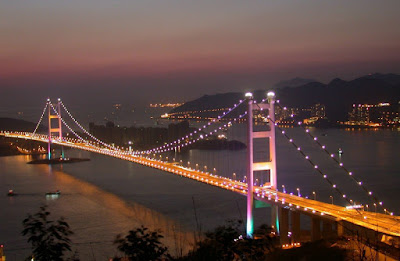
Hong-Kong Macau Sea Bridge

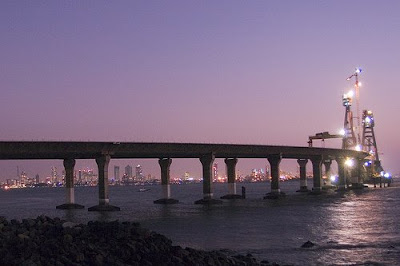
Bandra Worli Sea Link
The case in point is the Worli Bandra sea link. Conceived in 1990s, the 20 Kms Western Freeway project was designed to reduce the traffic choke on Mumbai road arterials as well as reduce the traveling time for commuters in the commercial hub of India. 8 years after the project had progressed, only half the number of lanes (4 out of 8) on a quarter of the actual length planned (5.6 out of 20 kms) is complete. That’s a project completion rate of 12.5% only in double the allotted time. Compare that with China, which has built 10 such sea links in 8 years. The Hong-Kong Macau sea bridge and the 32kms long Donghai bridge in Shanghai was completed in 3.5 years. The 43 Kms Hong Kong – Macau – GuangDong bridge will be built in 6 years.

Elsewhere in India, Delhi, the Metro Rail system is a better example of project management even though the same cannot be said for Common wealth preparation in Delhi.

Its time that all such projects are thoroughly examined by the state and centre governments and all and any causes of delay are penalized for incompetence. It is imperative that infrastructure projects are completed on time and schedule, for supporting the significant strides made by the Indian private sector.

Tuesday, January 20, 2009

Thumbs up for China, Thumbs down for India


I start this blog with 2 widely believed and unproven hypothesis. You would probably get to hear them more in the corporate boardrooms specially MNCs which have invested and done business with India.

Hyp. 1: India discounts it GDP growth by 2% on account of infrastructure unavailability. Whether be the lack of proper roads, or electricity, or governance, or airport infrastructure or just the red tapism in the bureaucracy. It is a significant deterant to the global super power dreams of India.

Hyp 2: India's growth has been powered more by its educated citizenry with government being a by stander in the growth. If any thing, the neta giri and the babu-dom have shackled the Indian executives and business more than giving them head room and leg room to grow. Mani Ratnam's Guru, had a 4 minute monologue by Abhishek Bachchan on the fetters that governance is putting over capitalism in this country.

India ranks a lowly 122 amongst 181 economies in terms of "ease to do business index", a reportpublished by the world bank group. Only African nations and war torn economies are more difficlut than India in terms of ease to do business! So much so for an economy whihc is the second fastest in the world in terms of growth.

Vodafone’s global CEO Vittorio Colao made his point clear in the CII conference on 19th January 2009, that India must offer increased clarity on its foreign direct investment across sectors. The(FDI) policy in India is complex and lends to multiple interpretations. Companies work on their legal interpretation of the policy and sometimes, find that they have tripped onto the illegal side of things as per policy.
What ever interpretation we give to the Indo - China ascendancy, whether be the tiger or the elephant and the dragon; policy makers in India should understand this clearly as anything else, we are in the competition of global investment. Better products, better services, better jobs are only possible if, suitable climate is provided to businesses to perform. As a first hand, i am aware of the "gifts" that lobbies and corporates bestow on the Babus in the state and union to see that the businesses continue unhindered. Bribes form a part of the deal, right from the CEOs office to the ground of action where the municipal clerks and the policemen are "taken care of". I was not wonder struck, when one of these opinion polls revealed that Indian corporates are least averse to paying bribes for smooth functioning of their operations.

Even China is state controlled to a very large extent. However, the difference is stark. The Dragon's speed, growth and efficiency is a product of the state governance. It is top down , while for India it is bottom up. Without a doubt, in the long run, a bottom up is more beneficial. However, in the present circumstances, it is dragging the resurgence down below.

In an earlier blog, i had mentioned, 2009 being the election year will mean a plethora of populist measures. The exchequer is going to bleed and the onus for making up on the losses will be laid squarely on the shoulders of corporate India. Already, i believe that the upward revision of 3G licensing fees from Rs.1650 crore to Rs.4040 crore makes it a untenable option for business houses. Unviability will lead to slower roll outs impacting services standards in the country. But really, does any one care?