Showing posts with label Infrastructure. Show all posts

Sunday, June 21, 2009

New Tools, new approaches

An excellent article reproduced from Mint's article on comparison on collaborative growth (Chinese approach) versus Inclusive growth (Indian Approach) by S Narayan (former finance secretary and economic adviser to the government).http://www.livemint.com/2009/06/21203159/New-tools-new-approaches.html?h=D

China is focusing on massive infrastructure investment--less than 40% of this is from its central budget

There is a quiet in the corridors of government, and people in the know attribute it to ministries getting down to serious work. There is evidence of cleaning up in several ministries, with changes in the higher echelons of bureaucracy and a revamp of the personal staff of some ministers. The Budget is only a couple of weeks away, and the big companies are making effective use of the media to lobby their requests for tax breaks and tariff reductions. There has been a very good article by Narayana Murthy of Infosys that recommends downplaying the Budget into a revenue-balancing exercise and focusing on deliverables and programmes.


The Prime Minister has made it clear that he wants growth back to double digits, and the good news is that inflation is also falling. There is sufficient liquidity in the system, and there are investors willing to back the equity markets. The poor monsoon is cause for worry, but many financial firms are upgrading India’s 2009 growth prospects.


Financial investment firms upgraded prospects for China as well, based on the financial stimulus packages announced by that government. China has just announced $20 billion loan assistance to Russia, clearly indicating its financial superiority. It is interesting to compare the policy approach for stimulus used by China with that in India. The (Chinese) approach followed has been to focus on a massive infrastructure investment programme of half a trillion dollars. Interestingly, less than 40% of this is from the Chinese central budget—the local governments have been asked to find the balance and to implement the programmes. Banks have been asked to lend to provincial governments for this purpose, and liquidity infusion into the economy is through credit for infrastructure projects. There is, thus, an incentive for provincial governments to take up and implement long-needed projects, and the financial wherewithal to do it. Implementation is monitored through a simple incentive—governors who do well will be rewarded in the party hierarchy; others will not. Among the more important programmes is environment—cleaning waterways, urban waste management and water supply.


Let us compare this with the policy pronouncements made in the President’s address and in the Prime Minister’s letter to his cabinet colleagues. The focus is on “inclusive growth” that would be achieved by extension of the National Rural Employment Guarantee (NREG) programme, an Act to mandate food security—an extension of the NREG programme to urban areas, and liquidity infusion is through bank lending for the private sector and directed lending for agriculture. In short, while increases in liquidity are being targeted in China for the construction of infrastructure and the provision of improved services to citizens, in India it is being used for social welfare programmes and assisting the private sector. We could have done what China is doing, as we have a huge publicly owned banking system, and a federal structure that can reach to state governments and all major cities. Just imagine the benefits if the government had announced a major infrastructure programme in every major town over a one-million population, and left it to the local bodies to implement it, within technical and quality parameters laid down nationally—we would have our cities cleaned up and liveable in five years!


In the rural sector as well, something different is possible rather than granting agricultural loans and writing them off, leaving the farmer no better off. In investment terms, when banks give an agricultural loan, they are “long” on the crop— volume and prices, until the crop is ready. This is a financial risk taken by banks without adequate cover, given the volatility of crop yields and prices and the vagaries of the monsoon. This is the real subprime that hits bank balance sheets and government finances year after year. It should be easy to provide instruments in the markets where this risk could be mitigated by a vibrant spot and futures market of products. If agricultural produce could be stored and quality tested, then the receipts become marketable, with assured delivery at the end of the contract. From this, it is easy to develop futures and options that will mitigate risk. In effect, the bank lending for agriculture can continue, and the market would mitigate the risks of this lending through price and volume discovery that is transparent. Farmers would be benefited through a clear price for their products, middlemen would disappear, bank risk would be mitigated, and government interventions avoided. All that is needed is to create state-specific exchanges where such transactions can take place under the state regulators (under the Agricultural Produce Marketing Committee Act), and encourage farmers to participate.


It is important to think of new approaches. The pattern of programmes outlined by the government is a revisit of the rural development and poverty alleviation programmes of the past several decades, without any attempt to learn from their failures or think in terms of the new, young, urbanizing population of today. The needs of the people, as well as their aspirations, have changed and perhaps we should use the new tools at our disposal in the financial and services sectors to deliver what the citizen expects.

Thursday, June 18, 2009

Are Infrastructural Shortages stiffling India

Two seemingly unrelated news articles in Mint today and yet the connect between both of these is mighty and huge.

The first one is about World Bank raising the its forecast for China’s economic growth from 6.5% to 7.2%. This was due to strong government investment supporting growth of the economy.

The second article was a report on the delays in Mumbai’s Bandra-Worli sea link. The project is being opened this month after a four year schedule delay.

Yours truly, had the opportunity to visit China early this month and the two things that impressed me about China were:
Infrastructure that is at-least 10 – 15 years ahead of India.
The investor and business friendly legislations. The scale of Industry and SEZs and the tax exemptions to the industry.
China had embarked on the journey of open market economic liberation 12 years before India had. However, what seems evident in China is the way they have managed the madness of trade and economic liberalization. They built roads and bridges and power stations and ports and aerodromes to handle growth. India went about all this in a pretty unstructured way vacillating between governments and politics. The result is obvious: China, the most populous state in the world, the third largest economy in the world grows fastest, while the Indian Juggernaut is still taking off.

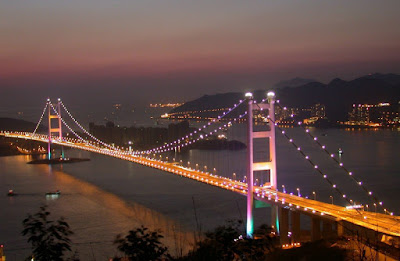
Hong-Kong Macau Sea Bridge

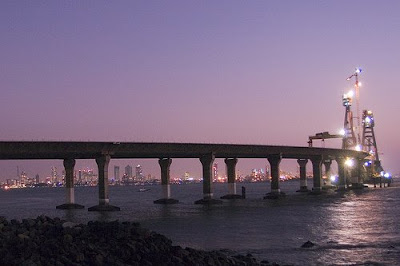
Bandra Worli Sea Link
The case in point is the Worli Bandra sea link. Conceived in 1990s, the 20 Kms Western Freeway project was designed to reduce the traffic choke on Mumbai road arterials as well as reduce the traveling time for commuters in the commercial hub of India. 8 years after the project had progressed, only half the number of lanes (4 out of 8) on a quarter of the actual length planned (5.6 out of 20 kms) is complete. That’s a project completion rate of 12.5% only in double the allotted time. Compare that with China, which has built 10 such sea links in 8 years. The Hong-Kong Macau sea bridge and the 32kms long Donghai bridge in Shanghai was completed in 3.5 years. The 43 Kms Hong Kong – Macau – GuangDong bridge will be built in 6 years.

Elsewhere in India, Delhi, the Metro Rail system is a better example of project management even though the same cannot be said for Common wealth preparation in Delhi.

Its time that all such projects are thoroughly examined by the state and centre governments and all and any causes of delay are penalized for incompetence. It is imperative that infrastructure projects are completed on time and schedule, for supporting the significant strides made by the Indian private sector.

Monday, March 16, 2009

Delhi's Commonwealth Tamasha

There are less than 18 months to October 2010, when Delhi will be hosting the Commonwealth games. It will be a world stage where India will exhibit its own progress and panache much like China did it in the 2008 Olympics and Sydney did it in 2006 Commonwealth. However, the road to Commonwealth has been bumpy, patchy and with a reason, non existant. In an earlier post, i had covered the state of (un)readiness of Delhi to host an event so large in magnitude and scale. http://newspaper-posts.blogspot.com/2009/03/delhi-running-out-of-time-on.html

Lately, Australian Commonwealth Games Association, has issued a threat to pull out of the Delhi CWG if its security concerns are not met. The security assessment a month before the games would be critical in terms of Australian contingent proceeding with their participation. It comes on the back of the attack on Sri Lankan Team in Pakistan. Earlier, the centre government had sanctioned Rs.78.26 crore for security arrangements (after the Sri Lankan team episode in Pakistan).

While security is the top most in the list of priorities, Infrastructure addition to the city has also been a concern. A few interesting notes about the same:

1. The longest flyover in Delhi, which will connect the 5 kms stretch from Jawaharlal Nehru Stadium to the Games Village bypassing Sarai Kale Khan and Nizamuddin West will be built at a cost of Rs.5 billion! This will facilitate movement of 10000 atheletes from the games village to the main stadium. This project is expected to be finished in 24 months!
Please note, the 24 month project starting date (March 2009) onwards would mean that the fly over will not be fully available ort may be partially available for the task it is being built for!

2. Earlier this flyover was supposed to be a tunnel road which was rebuffed by the Archeological Survey of India fearing danger to Humayun's tomb!
So much for town planning and preparation for Games

3. While MCD tries to expedite the projects at hand, it is now eating some of its own medicine as it faces resistenace from the environment department of Delhi Government. The widening of the the road to Karni Singh Shooting range has hit the breaker (after being stuck for 6 months anyway) because widening of the road would require felling 400 trees, which is not permitted.
So a "one- way" solution is being thought about.
Did the MCD involve other stake holders in the goverment when they had first envisaged the locations of the games? The answer seems to be no!

4. In a report to the chief justice K.G.Balakrishnan, town planner and former chairman of Delhi Urban Arts Commission, Charles Correa has advocated that the badminton and the squash stadiums be moved away from Siri Fort Indoor Stadium to elsewhere for the purpose of preserving the the green in the area. MCD is now looking at other options with a Rs.1.5 billion kitty for Squash and Badminton stadiums!
Alternate options had never been prepared. Old Sites were being counted upon. With the development tactic backfiring on issues such as environment it will be interesting to see how MCD generates options for the CWG

Tuesday, March 3, 2009

Delhi: Running out of time on Commonwealth

A sequel to my earlier post : A system in Rot, http://newspaper-posts.blogspot.com/2009/03/system-in-rot.html, this blog post takes the lack of seriousness of governance and Bureaucracy to the next level: How is it going to affect the 2010 Commonwealth games in Delhi?

China's Beijing Olympic dazzle left the world glittered in its awe and won it some great acclaim world over. In 2006, Melbourne hosted the Commonwealth Games and rasied the bar ever so much. In 2010, the Commonwealth games move into India and Delhi. Its less than 18 months here on to the games and Delhi looks not even to have started the preparedness to the Commonwealth. A parliamentary report tabled at the Rajya Sabha has slammed Delhi Government's preparedness on the Commonwealth and yet the Delhi sport minister, Manohar Singh Gill has side stepped the concern, likening the preparation for Commonwealth to a great Indian wedding, where everything comes together just on time before the opening ceremony. For the government that was elected on its progress agenda, Shiela Dixit and her men, are in adenial to face realities that they face. Worse, adhocism and procastrination in terms of infrastructure development leading to this event may dent India's image significantly in the world communities but no one seems to be bothered about it really. All that is in the air, is the election and its doesnot seem like there will be any awareness and action on this till about June 2009, which will only leave 15 months to the Opening ceremony.

The Games Village, the facilities around, the roads and transport, the security, the airports,the  water and power supply, nothing seems to be in place for this spectacle. In absence of any serious call to action, the image that India may project in front of the 71 participating nations may not be a very flattering one. According to press reports, the Commonwealth boxing championships have already been pushed back from December 2009 and the vice president of the international swimming federation has already slammed the organisers for the poor facilities.

The ministers answers, the CAG report on delays in project completion, ruefully point to the deliberate lack of seriousness in efforts to develop infrastructure. If this be the case in Delhi, which is the capital of this country, imagine what be it in far off places (India being a geographical and economically diverse country!). Corruption, schedule overruns, rampant mis-use of public funds, lack of foresight in policy decisions and ballooning funds are going to sink the ship, even before it takes to the high seas. A damning statistic over here: out of 519 infrastructure projects scheduled by the central government, 258 are running behind schedule (50%) and the cost overruns are 13.4% (from 344119 crores to 390230 crores). 

It is time to step up the gas, and probably at this time, it is worth inviting private participation of infrastructure companies to speeden things up for a change.


Sunday, March 1, 2009

A system in rot

In one of my earliest blog posts in September 2008, i had debated the state of Indian roads with the Mint editor Raju Narisetti.
http://newspaper-posts.blogspot.com/2008/08/of-infrsatructure-and-capital.html
http://newspaper-posts.blogspot.com/2008/09/of-infrastructure-and-capital.html

The debate on accountability for the bad state of infrastructure has been re kindled by the CAG report which was reported by TOI:
http://timesofindia.indiatimes.com/Delhi/55_of_roads_okayed_by_MCD_substandard_CAG/articleshow/4203120.cms
The report brings forth the following points
  1. MCD accepts substandard road work from contractors insteda of opting for minimum quality standards. Third party checks on 20 roads built between 2003 and 2008 reported 55% of the roads below standard.
    42 roads have been damaged during the warranty period and there have been no repairs made on to them. This was while the warranty covered all costs of repairs.

  2. 5 newly built roads made at a cost of Rs.3.18 crores were accpeted by the MCD where as third party checks by the CAG have found them to be substandard.

  3. Of 304 RWAs (resident welfare associations) surveyed 77% have reported bad roads in their colonies and 71% have said that the roads in their colonies have not been repaired even once in the last 5 years.

  4. Of the total allocation of monies for road development, MCD has routinely diverted the money to purchase of vehicles, computers, hiring of vehicles and office work constructions.

  5. Contractors delay the road work routinely, and though they should be fined for it, none of they are ever penalised courtesy MCD.

  6. On an average 87% of the total project contractual work amounts are duly paid up to the contractors, with out any completion of work.

  7. Monies collected from other agencies for road development lies sorely under utilised.

  8. MCD has been commissioning quality checks without mandatory quality checks 53% of the times.

  9. A third of MCD assets such as drainage, sewage, roads and subways are in a state of neglect.

These are just about gaping wide craters in the system, sucking up the taxpayers money and distributing it to a few pockets in the MCD and the Government machinery. While fraudsters and scamsters are tried, penalised and punished, the MCD - Government nexus which is probably a shade worse in fraud, scmas and misuse of public money go about becoming more powerful and more irresponsible and more corrupt in their ways. One would have to give the kudos to CAG to bring such facts on the table. But one needs a more wilful, accountable and "aware" governance to fight se evils of the system.

Monday, November 24, 2008

Hope in the horizon, obstacles in the vicinity (Part II)

Thus in true sense, amongst the drivers of the economy, it is the service sector which is getting all the growth for India. India is woefully short of adequacy in manufacturing and agricultural sectors. This is not a revelation but an accepted truth across the nation.By and large this has been because basics such as healthcare, drinking water and infrastructure has not been distributed equally and in overall terms are in-adequate.

Thus the state and central governments need to prioritize on building roads, providing safe water and health care, meeting the power needs of the country, work on irrigation projects for year round water supply to farms and bring business revenues under the tax net.

India has had a political record where good governance and populist measures have not gone hand in hand. It is time to realise that Good governance translates to longer terms at offices if you are working right and working at the basics. Else the divide between the elite class in the cosmopolitan (India 1) and the masses (India 2) will keep increasing. An India 1 and India 2 story is amusing but dangerous in its long term effects where there will be constant constraints at growth and we will not be able to realise the full potential of India. It also risks a civil unrest. Getting these two Indias together will fire the growth engine. That would ultimately take India to its glory story 10-15 years in the future.

Saturday, September 6, 2008

Of Infrastructure and Capital Statements II

(extending the discussion with Raju Narisetti, the Editor of Mint, my views on the bad quality of the infrastructure is extended thru ths discussion. http://blogs.livemint.com/blogs/romanticrealist/archive/2008/09/01/killer-roads-in-india-and-rethinking-the-death-penalty.aspx?CommentPosted=true#commentmessage )
Hi Raju
Capital Punishment is a compelling thought. However is that a panacea of the corruption evils? Hardly! In my views, i tend to agree with Arm Chair guy. The bad quality of roads is just the precuror. From environment to poverty to health care, education and business and more... bad governance prevails everywhere.Corruption is omnipresent! To take the points i suggested a little further
1. As a corporate executive i have metrics, tolls, reviews and score card. I am evaluated on the basis of that.
2. For a business as large as 1 billion people and a trillion dollar economy, where are these management/administration fundamentals? Who does the check? Where are the audit reports
3. Media has been up in arms trying to go after such issues, but that is more from a sensationalizing stand point.Good media is impartial and we seriously need media to start educating the millions.
4. There is this office of the president/governor.That to me is a complete drain on the exchequer unless they can take the position, of safeguarding the public interest. Can they do the audits?
5. I again come back to my previous claims. Socially responsible people need to review and evaluate the government and the officials...Media is to be the voice of the people / neutral medium and the enabler is to be the gubernatorial offices.
I know the constitution doesnot provide any framework on this.. But then we need to start some where.
Finally on the roads infrastructure front, extending Arm Chair guy's thoughts... If a Samsung can Guarantee its TVs, the road contractors must guarantee the quality of their work. If it fails within the guaranteed time, they need to redo without being paid... Manas

Thursday, September 4, 2008

Realty Sector, Investments and a possible growth story

(This post deals with a view about realty sector players in the Indian Market,especially DLF. Read full details at ... http://www.livemint.com/2008/09/05003413/DLF-yet-to-start-work-on-Mumba.html)

Hi Madhurima
No one contests the financial might and lobbying abilities of the collossus, DLF.However in the regime of increasing interest rates and plataeuing consumer demand, (read recessionary symptoms/ slowdown), i am not surprised that DLF is going slow.
1. As of now, it seems that DLF has invested more than it is comfortable with in a horizon which is uncertain. Consumer demand is not exactly the shade of pink it used to be.
2. While partnerships with other real estate cos, would help DLF tide over the credit/cash crunch, yet the cash flows from exiting projects would not be as promising.
3. There would be some inventory (ready to move in, unsold properties) which DLF would be stuck with.
4. Hence the delays and slow execution...
5. Compare it with players such as Indiabulls etc, who donot have significant inventory at hand. Hence they can continue to invest, from their P&L standpoint.
6.One thing that really beats me is most of the projects that are being advertised, are targetted to the Medium High level consumer. We havent heard of mass housing schemes. Thats where most of the real estate companies are missing the trick.
7. Mass housing solutions (i remember Brazil having done one of these projects successfully) would be key to spurring growth in this sector in the years to come.
8. Besides, the development at the tech parks and SEZs that has happened has been much unplanned and infrastructurally bottled up. One just needs to see the Cybergreens/Gurgaon and Hyderabad at peak hours to understand how badly the projects were concieved.
9. Bottomline... Cos like DLF will have giant successes and those irritating nags that will be a cash drain. DLF probably needs to look at more economical solutions catering to wider audience solutions in "building India".
Thanks

Sunday, August 31, 2008

Of Infrsatructure and Capital Statements

( .. furthering the course of discussion on the pathetic quality of roads in India, this was a post that i had written in reply to Raju Narisetti's (editor in Chief, Mint) editorial piece on pathetic road infrastructure in India. Click http://blogs.livemint.com/blogs/romanticrealist/archive/2008/09/01/killer-roads-in-india-and-rethinking-the-death-penalty.aspx?CommentPosted=true#commentmessage for the story)

Hi Raju

Off all things, i cant imagine why you would have to toil in some obscure hill way, a Highway 58 or something. Did you miss the roads outside your home/office/club/mall/market etc? If my memory does me fair justise, the utility of tax payers money diminishes by exponential degrees as you move out of Delhi/or the state capitals.And i am still talking Delhi! We dont have a concept of time value of Money in India else the amount that we lost in the traffic jams and on roads would be incomprehensible. It takes only one good monsoon to show how poorly off we are in the quality of road infrastructure. As far as your China comparison is concerned, the common perception of India's GDP growth is that we loose 2% growth opportunity because of infrastructural shortages and shortcomings (whether be road, electricity, water, or any other). So when India was scorching at 9% GDP growth, the common perception was we could actually do a 11% and we were loosing 2% to these bottlenecks. I wonder if China works on discounting their infrastructure. Responsibilibity and accountability go hand in hand: Thats as far as i understand is a universal principle. Universal, right till about it steps to the Indian Policy makers. This may sound crazy and indeed as a action point radical , but who audits the government. Are there any scorecards for the governments and policy makers. Inside the parliament, its just as good as a thief judging the theivery of another. Why cant we have a group of business icons/media people/environment specialists/economists/ social activists, take a yearly account of the policies and the governments? A public death penalty is not as much the answer as an answerable system is. In a mature world, i would vote for rational assessments instead of radical penalties.

Thanks

Regards