


Language Sms
16 years ago
 The crisis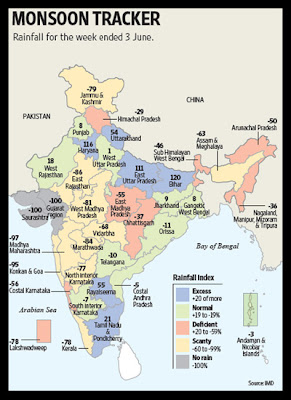
The Impact
Drought is the most eminent risk of the El Nino fall out with Khariff crops being at risk.Technically speaking a Rainfall deficiency of 10% or more is defined as a drought. Since, 55-60% of the Khariff crop is dependent on Monsoon, a small variation in the rainfall totals can impact the crop very adversely, There has been a drastic dip in water reservoir levels across several states. In nearly 80 national reservoirs, the water stored is 1/3rd less compared with the same time last year.and if not replenished during monsoons, irrigation water will be deficient, because drinking water needs would come first.
Long Term Damage and Control
The current year’s monsoon is considered to be crucial for the economy as buoyant rural consumption has been a key driver of growth amid an economic downturn (read http://www.livemint.com/2009/04/17234039/Monsoon-booster-for-rural-dema.html?d=1). While the country has sufficient food stocks to tide over any crisis this year, the macro economic pressure is expected to accrue on account of food price inflation.
In Orissa, Industries have been asked to cut down their production levels, because of low reservoir levels resulting in low electricity generation. Power deficit levels are expected to be 20 – 30%, even in a power surplus state like Orissa. Elsewhere in Chattisgarh, the Government has already purchased and stored 370,000 tonnes of rice and is ready to procure rice from outside as well. Madhya Pradesh is worst off in terms of reservoir crisis. Reservoirs which were full last year, are all running empty.
A shortfall in rainfall could also impact the power generation in the country. Agricultural demand for power would go up and power availability from hydroelectric projects would come down. This would impact the power supply position in the country.
Source: Truant rains could nix nascent recovery: http://www.livemint.com/2009/06/22235043/Truant-rains-could-nix-nascent.html?pg=1
Also Read: Changing Monsoon trends: http://www.livemint.com/2009/04/30222403/Changing-monsoon-trend-forces.html?d=1
http://www.livemint.com/2009/05/25092131/Monsoon-hits-Indian-coast-ear.html?d=1
A new section in Newspaper Posts, Tongue In Cheek, is about interesting facts and annecdotes concerning the world around us. Your comments as always are welcome.
Approximately 40% of the farm produce (Fruits and Vegetables) in India is wasted in the absence of organized cold chain network in the country.
An excellent article reproduced from Mint's article on comparison on collaborative growth (Chinese approach) versus Inclusive growth (Indian Approach) by S Narayan (former finance secretary and economic adviser to the government).http://www.livemint.com/2009/06/21203159/New-tools-new-approaches.html?h=D
China is focusing on massive infrastructure investment--less than 40% of this is from its central budget
There is a quiet in the corridors of government, and people in the know attribute it to ministries getting down to serious work. There is evidence of cleaning up in several ministries, with changes in the higher echelons of bureaucracy and a revamp of the personal staff of some ministers. The Budget is only a couple of weeks away, and the big companies are making effective use of the media to lobby their requests for tax breaks and tariff reductions. There has been a very good article by Narayana Murthy of Infosys that recommends downplaying the Budget into a revenue-balancing exercise and focusing on deliverables and programmes.
The Prime Minister has made it clear that he wants growth back to double digits, and the good news is that inflation is also falling. There is sufficient liquidity in the system, and there are investors willing to back the equity markets. The poor monsoon is cause for worry, but many financial firms are upgrading India’s 2009 growth prospects.
Financial investment firms upgraded prospects for China as well, based on the financial stimulus packages announced by that government. China has just announced $20 billion loan assistance to Russia, clearly indicating its financial superiority. It is interesting to compare the policy approach for stimulus used by China with that in India. The (Chinese) approach followed has been to focus on a massive infrastructure investment programme of half a trillion dollars. Interestingly, less than 40% of this is from the Chinese central budget—the local governments have been asked to find the balance and to implement the programmes. Banks have been asked to lend to provincial governments for this purpose, and liquidity infusion into the economy is through credit for infrastructure projects. There is, thus, an incentive for provincial governments to take up and implement long-needed projects, and the financial wherewithal to do it. Implementation is monitored through a simple incentive—governors who do well will be rewarded in the party hierarchy; others will not. Among the more important programmes is environment—cleaning waterways, urban waste management and water supply.
Let us compare this with the policy pronouncements made in the President’s address and in the Prime Minister’s letter to his cabinet colleagues. The focus is on “inclusive growth” that would be achieved by extension of the National Rural Employment Guarantee (NREG) programme, an Act to mandate food security—an extension of the NREG programme to urban areas, and liquidity infusion is through bank lending for the private sector and directed lending for agriculture. In short, while increases in liquidity are being targeted in China for the construction of infrastructure and the provision of improved services to citizens, in India it is being used for social welfare programmes and assisting the private sector. We could have done what China is doing, as we have a huge publicly owned banking system, and a federal structure that can reach to state governments and all major cities. Just imagine the benefits if the government had announced a major infrastructure programme in every major town over a one-million population, and left it to the local bodies to implement it, within technical and quality parameters laid down nationally—we would have our cities cleaned up and liveable in five years!
In the rural sector as well, something different is possible rather than granting agricultural loans and writing them off, leaving the farmer no better off. In investment terms, when banks give an agricultural loan, they are “long” on the crop— volume and prices, until the crop is ready. This is a financial risk taken by banks without adequate cover, given the volatility of crop yields and prices and the vagaries of the monsoon. This is the real subprime that hits bank balance sheets and government finances year after year. It should be easy to provide instruments in the markets where this risk could be mitigated by a vibrant spot and futures market of products. If agricultural produce could be stored and quality tested, then the receipts become marketable, with assured delivery at the end of the contract. From this, it is easy to develop futures and options that will mitigate risk. In effect, the bank lending for agriculture can continue, and the market would mitigate the risks of this lending through price and volume discovery that is transparent. Farmers would be benefited through a clear price for their products, middlemen would disappear, bank risk would be mitigated, and government interventions avoided. All that is needed is to create state-specific exchanges where such transactions can take place under the state regulators (under the Agricultural Produce Marketing Committee Act), and encourage farmers to participate.
It is important to think of new approaches. The pattern of programmes outlined by the government is a revisit of the rural development and poverty alleviation programmes of the past several decades, without any attempt to learn from their failures or think in terms of the new, young, urbanizing population of today. The needs of the people, as well as their aspirations, have changed and perhaps we should use the new tools at our disposal in the financial and services sectors to deliver what the citizen expects.
A new section in Newspaper Posts, Tongue In Cheek, is about interesting facts and annecdotes concerning the world around us. Your comments as always are welcome.
Twitter has roughly 6 million users and is projected to grow to 18.1 million users by 2010. The next Black Swan in making?


 Posts
All Comments
Posts
All Comments


